
 spacestrategies.org

Key Findings
- 25 stakeholders mapped across 6 categories; power concentrates in 4 key players (DoD/Space Force, SpaceX, Congress, the White House), while the 10 agencies and firms most actively engaged with space governance lack the authority to shape it.
- SpaceX holds 60% of National Security Space Launch (NSSL) Phase 3 Lane 2 and 100% of Lane 1 missions , exercises structural capture through procurement dependency rather than traditional lobbying, and operates Starshield’s 100+ classified satellites without statutory accountability.
- 3 incompatible acquisition models coexist within DoD (SDA spiral development , NSSL concentrated providers , MDA’s 2,380-vendor marketplace ), reflecting institutional fragmentation that three consecutive administrations of executive directives have failed to resolve.
- 8+ Congressional committees claim space jurisdiction, creating a self-reinforcing veto structure that has blocked mission-authorisation legislation for over a decade despite broad expert consensus.
- Institutional reform lags technology deployment by a wide margin: Starlink deployed 7,000+ satellites in approximately five years; the governance framework governing those satellites has not advanced at all.
Executive Summary
The United States does not have a space policy. It has competing institutional logics – the Pentagon seeking operational control of commercial constellations, the Department of Commerce promoting export competitiveness, NASA brokering public-private partnerships, and Congress fragmenting oversight across eight or more committees. This analysis maps the actors, relationships, and coalition dynamics that determine whether this fragmented architecture is a structural advantage or a strategic vulnerability, and finds that the answer depends on which domain you examine: fragmentation drives commercial innovation but cripples governance coherence and military integration speed.
The Stakeholder Landscape
The most striking feature of the US space governance map is not who holds power but the disconnect between formal authority and actual influence – the agencies formally charged with regulating space sit in the lower tiers of the power hierarchy, while a single corporation has accumulated more structural leverage over national security space than any private entity in American history.
The Issue and Its Actors
The United States is in the second space race without a unified governance architecture for running it. The Department of Defense treats commercial constellations as augmentation assets and pushes for priority access. The Department of Commerce promotes export competitiveness and minimal regulation. NASA brokers milestone-based partnerships with distinct risk tolerances. The FCC manages spectrum allocation under its own mandate. And Congress – through eight or more committees with overlapping jurisdiction – fragments oversight so thoroughly that no comprehensive space legislation has advanced in over a decade.
The decisions at stake are not abstract. They include the regulatory framework for novel space activities such as in-orbit servicing and active debris removal, the terms under which the Pentagon integrates commercial capability into warfighting architecture, the governance of commercially controlled infrastructure that serves national security functions, and the allocation of shrinking civilian budgets across regulatory agencies facing a 16.6% non-defence funding reduction . These decisions unfold against China’s integrated civil-military space architecture – a unified command structure that filed for 200,000 satellites at the ITU in December 2025 and established an Aerospace Force in May 2024 .
Twenty-five stakeholders populate this map, spanning government agencies, corporations, industry associations, think tanks, and allied nations. Power concentrates heavily among four key players, while ten agencies and firms with deep engagement in space governance lack the authority to resolve the structural tensions they navigate daily.
Who Matters and Why
| Low Interest | High Interest | |
|---|---|---|
| High Power | Keep Satisfied: NRO, CFIUS | Key Players: DoD/Space Force, SpaceX, Congress, White House/NSC |
| Low Power | Monitor: Insurance industry, academic community | Keep Informed: SDA, Commerce/BIS, NASA, Amazon/Kuiper, FCC, ULA, L3Harris, Rocket Lab, think tanks, allied nations |
The Key Players quadrant is dominated by institutional actors plus one corporation – SpaceX. In most governance analyses, corporations sit in the Keep Informed or Keep Satisfied (keep them satisfied to prevent them from using their considerable power in a negative way or to hinder you, but without “overwhelming” them with a constant stream of information) quadrants. SpaceX’s presence alongside DoD and Congress reflects its position as the monopoly provider of critical national security infrastructure, a form of leverage normally reserved for sovereign entities. The Keep Informed quadrant, meanwhile, is overcrowded with the agencies and firms most actively working on space governance, signalling that the actors closest to the problem lack the power to resolve it.

The Players and Their Web
Four actors hold the decisive cards in US space governance, but none of them holds a winning hand alone. Each commands significant power, each faces internal contradictions, and the relationships between them define the boundaries of the possible.
DoD / Space Force: Three Pentagons in One
The Department of Defense is the largest space spender, with procurement authority over national security launch and classification powers that can render entire programmes invisible. It is also the most internally divided key player. Three acquisition models operate simultaneously: the Space Development Agency’s spiral development approach , which awards contracts to broad fields of commercial providers and iterates rapidly through satellite tranches; the National Security Space Launch programme , which concentrates missions among two providers for cost certainty; and the Missile Defense Agency’s SHIELD marketplace , which opens a $151 billion ceiling to 2,380 vendors in pursuit of maximum competition.
These three models embody three incompatible theories of how government should relate to commercial space. They coexist not by design but because three consecutive administrations issued integration directives that the acquisition workforce’s institutional incentives overrode. The Defense Science Board’s own findings confirm the structural diagnosis – government is “wary of commercial services’ long-term reliability” and “hesitant to cede control over missions it views as inherently governmental” – yet policy directives continue to be issued without addressing this institutional resistance. The most consequential veto in US space governance is this veto by omission: the absence of Space Force service-level guidance for operationalising commercial services means that commercial capability remains “augmentation” by institutional default, regardless of what any policy directive says. The formal process is formally followed and substantively nullified.

SpaceX: The Corporation That Became Infrastructure
SpaceX occupies a position without historical precedent in American national security. It holds 60% of NSSL Phase 3 Lane 2 and every Lane 1 mission . It operates over 7,000 Starlink satellites and more than 100 classified Starshield spacecraft . Its launch cost – approximately $212 million per mission versus $282 million for ULA and $341 million for Blue Origin – makes alternatives uneconomic at scale. And its founder maintains direct executive branch access through the Department of Government Efficiency.
This is not traditional corporate influence. SpaceX exercises structural capture through dependency rather than lobbying. It does not need to advocate for contracts; the absence of alternatives at scale makes it the default choice. When GPS III missions transferred from Vulcan to Falcon 9 after launch anomalies, the transfer demonstrated that even when the Pentagon contracts with competitors, operational necessity routes missions to SpaceX. Starshield satellites operating in civilian frequencies between 2025 and 2110 MHz – detected by independent monitors but neither confirmed nor denied by authorities – represent governance by infrastructure deployment: operational facts established in orbit without regulatory authorisation. The Pentagon’s characterisation of SpaceX as “forward leaning” and critics’ characterisation of it as a “gatekeeper in orbit” describe the same structural reality from different vantage points.
Congress: The Veto That Cannot Decide
Congress commands the appropriations power, the oversight authority, and the legislative mandate that every reform proposal ultimately requires. It is also the institution most structurally incapable of using those powers coherently. Eight or more committees claim jurisdiction over different aspects of space policy – defence committees over military space, commerce committees over exports and regulation, intelligence committees over classified programmes, science committees over NASA, and appropriations subcommittees over all of the above. Each committee chair protects jurisdictional prerogatives. No committee will cede authority to enable comprehensive legislation. The result is a self-reinforcing veto structure that has blocked mission-authorisation legislation for over a decade despite broad consensus among experts, industry, and executive agencies that it is urgently needed.
The most reliable legislative vehicle for space governance evolution is the annual National Defense Authorization Act. Defence committees can insert provisions directing DoD commercial integration terms without resolving the broader jurisdictional tangle. But this pathway militarises space governance by routing all reform through defence legislation, narrowing the governance aperture even as the governed domain expands into civilian and commercial territory.
The White House: Authority Without Durability
The White House – through the National Security Council, the National Space Council, and executive orders – is the only institution with formal authority to resolve interagency coordination failures. Former Assistant Secretary of Defense for Space Policy John Plumb identified “seam issues of national importance” in positioning, navigation, and timing, space traffic management, and dual-use governance that require White House-level resolution because no single agency can address them.
The problem is durability. Executive directives from successive administrations have been overridden by institutional incentives at the implementation level. The current administration’s budget signals – defence spending up 13.4%, non-defence down 16.6% , NASA reframed as a great-power competition instrument – suggest a strategic direction but not a governance architecture.
The Web of Relationships
The relationship architecture reveals a system structured around a single bottleneck. SpaceX connects to more actor types than any other node – the Pentagon through contracts, NASA through partnerships, Congress through oversight, the FCC through spectrum, allies through service provision, competitors through market pressure. This hub position is the network expression of its monopoly power and the structural source of governance fragility.
Within the defence cluster, DoD, SDA, NRO, and MDA form a tightly connected group with strong internal ties that mask internal incoherence. Each entity pursues a different commercial integration theory while maintaining institutional cooperation. The SDA-Rocket Lab relationship ($805 million contract) and the SDA-L3Harris ties represent deliberate efforts to broaden the industrial base. The Amazon/Kuiper-L3Harris alliance is the most strategically significant emerging relationship: a deliberate attempt to create a second structural bridge between commercial and military domains, challenging SpaceX’s monopoly bridging position.
Commerce and BIS, despite holding the formal regulatory mandate for export controls and commercial space, are structurally isolated – weak ties to most key players, tension with DoD over export competitiveness versus technology transfer controls, and no strong Congressional champion. Budget cuts deepen this isolation at precisely the moment the regulatory challenge intensifies. Think tanks – CSIS, the Secure World Foundation, Deloitte – form a coherent reform-advocacy cluster with moderate ties to Congress and weak ties to the White House. Their influence is informational, shaping discourse without commanding implementation.
Allied nations – the Five Eyes, AUKUS partners – maintain cooperative but friction-laden relationships with both DoD and Commerce. ITAR restrictions constrain the interoperability that alliance strategy demands, creating a tension between security controls and strategic partnership that no current institutional mechanism resolves.

The Dynamics
The map is drawn and the actors are positioned, but the system is not static – coalitions are forming, fracturing, and competing to define what “commercial space integration” actually means, and the most important finding is that three groups claiming to support it mean fundamentally different things.
Coalitions and Swing Dynamics
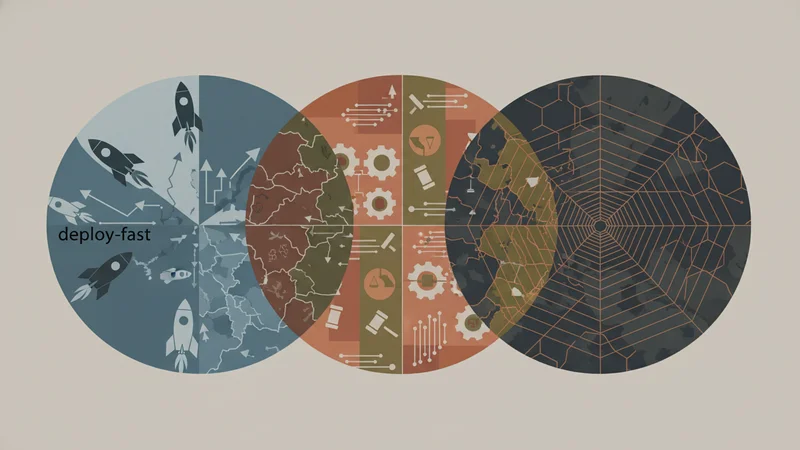
The surface-level political consensus – that the United States should integrate commercial space capability more deeply into national security operations – conceals a three-way fracture.
The first camp, “Deploy Fast,” centres on SpaceX and the Space Development Agency. Its operating logic is that commercial deployment speed is the governance lever. Regulatory reform is secondary to operational capability. Infrastructure facts established in orbit – Starlink coverage, Starshield operations, spectrum occupation – create the governance reality that rule-making eventually ratifies. This coalition’s power derives from procurement dependency and operational fait accompli. As one analysis framed it, “space governance is increasingly shaped by infrastructure, not the other way around.”
The second camp, “Diversify and Regulate,” brings together Amazon/Kuiper, L3Harris, Commerce/BIS, and the think-tank community. Its logic is that integration requires a statutory framework, multiple providers, and regulatory modernisation to avoid single-point dependency. Mission authorisation, commercial space traffic management, and provider diversification are its policy objectives. Its power is informational and aspirational – it has built intellectual consensus but lacks implementation authority.
The third camp, “Control and Own,” is rooted in the legacy DoD acquisition community, portions of the NRO, and the Intelligence Community. Its logic is that mission-critical infrastructure must remain government-owned and government-operated. The Starshield programme – 100+ satellites owned by the government but manufactured by SpaceX – is its compromise position, one that retains ownership while deepening manufacturing dependency. Its power is institutional: embedded in procurement regulations, classification authorities, and the cultural risk aversion of the acquisition workforce.
No coalition can prevail alone. The swing actors are the White House, which could issue an executive order consolidating space governance authority; Congress’s defence committees, which could legislate a statutory accountability framework if SpaceX governance risk crystallises into a security incident; the FCC, which could constrain Starshield spectrum operations and force governance negotiations; and Blue Origin, whose operational certification would create the credible second-source that alters structural dependency calculations.
The most consequential potential trigger is a SpaceX governance incident – an escalation of Congressional concerns about foreign contacts, a public Starshield spectrum interference controversy, or an operational decision with geopolitical fallout. Such an event would open a political window for the statutory accountability framework that no organised constituency currently advocates for.
What To Do Now
Three engagement priorities offer the highest strategic return.
First, track the Starshield/commercial service dual-track as the concrete expression of the Pentagon’s unresolved internal debate. DoD simultaneously owns Starshield satellites and purchases commercial Starlink connectivity, with the PLEO contract expected to reach approximately $500 million in consumption within its first year – a contradiction that will resolve in one direction or another as the SDA’s Tranche 3 (72 satellites by FY2029) either validates or undermines the spiral acquisition model. This dual-track is the single best indicator of which institutional logic is winning inside the defence establishment.
Second, monitor Congressional response to SpaceX governance exposure. The intersection of Musk’s foreign contacts, Starshield spectrum operations, and monopoly procurement dependency creates multiple potential trigger points for legislative action. Defence committee chairs hold the power to insert statutory accountability provisions into the NDAA – the most politically feasible pathway for governance reform. The question is not whether Congressional concern exists but whether it reaches the threshold that produces legislation.
Third, assess Amazon/Kuiper’s military SATCOM certification timeline as the critical variable for structural dependency. The L3Harris partnership, which embeds military requirements at the design phase, represents the most credible near-term challenge to SpaceX’s monopoly bridging position. If Kuiper achieves military certification and operational scale, the governance calculus shifts fundamentally: DoD gains negotiating leverage, the “Diversify and Regulate” coalition gains a material champion, and the structural capture dynamic weakens.
The single most consequential relationship to watch is the one between the White House and the Pentagon’s acquisition workforce. Every governance reform ultimately depends on whether executive direction can overcome institutional inertia at the implementation level – and successive administrations of evidence suggests it cannot, absent structural changes to the incentive architecture itself.
Strategic Implications and Limitations
The political feasibility of comprehensive space governance reform is low. The most probable trajectory is continued incremental adaptation through annual NDAA provisions, punctuated by crisis-driven legislation if a governance incident forces Congressional action. This trajectory militarises space governance by default, routing civilian-commercial governance questions through defence legislation because no other legislative pathway is open.
A winning coalition for reform would require the White House to provide sustained coordination authority, defence committees to accept statutory accountability for commercial infrastructure, and at least one credible second-source provider to reduce the structural dependency that gives the status quo its inertia. This alignment is plausible but not probable within the next 18 months.
Several limitations bound this assessment. Defence perspectives derive from think-tank analysis and reporting rather than direct institutional sources. The White House position is inferred from budget signals and historical pattern. Classified programmes – Starshield specifications, NRO procurement details – are systematically invisible. SpaceX’s structural position is evolving rapidly enough that the power map could shift materially within 12 months if Kuiper deploys, Blue Origin certifies, or a governance incident triggers legislative action. The analysis captures a system in motion, not a settled equilibrium.
The counterspace threat environment adds further urgency to this calculus. CSIS’s Space Threat Assessment 2025 documents advancing Chinese and Russian satellite manoeuvring capabilities, widespread GPS jamming and spoofing, and ongoing nuclear ASAT pursuit; the SWF Global Counterspace 2025 report catalogues comparable capabilities across twelve nations. Faster commercial integration requires looser controls; growing threats demand tighter security. The Deloitte analysis of the regulatory pacing problem – drawn from interviews with two dozen industry leaders and regulators – identifies this paradox as the structural driver of the Pentagon-Commerce tension. It cannot be resolved without institutional redesign.
Primary Sources & Research
Office of Management and Budget (2025). Fiscal Year 2026 Discretionary Budget Request – NASA Excerpts. NASA. https://nasa.gov/wp-content/uploads/2025/05/fiscal-year-2026-discretionary-budget-request-nasa-excerpts.pdf
NASA (2025). Commercial Low Earth Orbit Program Office. NASA. https://www.nasa.gov/johnson/commercial-low-earth-orbit-program-office/
NASA (2025). Space Communications and Navigation (SCaN). NASA. https://www.nasa.gov/scan/
NASA (2025). Office of International and Interagency Relations – Export Control. NASA. https://www.nasa.gov/oiir/
NASA (2025). Space Technology Mission Directorate. NASA STMD. https://www.nasa.gov/space-technology-mission-directorate/
NASA (2025). GeoXO Spacecraft Contract Award. NASA. https://science.nasa.gov/mission/geoxo
Loverro, D., Kitay, S. & Vaughn, W. (2025). The Commercial Space Imperative. CSIS Aerospace Security Project. https://csis.org/analysis/commercial-space-imperative
Swope, C. (2025). Bringing the Private Sector to Space. CSIS Aerospace Security Project. https://csis.org/analysis/bringing-private-sector-space
Mineiro, M. (2025). The Future of Space Policy in the Next Congress. CSIS. https://csis.org/analysis/future-space-policy-next-congress
Plumb, J. (2025). PNT Resilience in an Era of Great Power Competition. CSIS. https://csis.org/analysis/pnt-resilience-era-great-power-competition
CSIS Aerospace Security Project (2025). Space Threat Assessment 2025. CSIS. https://csis.org/analysis/space-threat-assessment-2025
Jensen, B. & McInnis, K. (2024). Using Artificial Intelligence to Rethink the Unified Command Plan. CSIS Futures Lab. https://www.csis.org/analysis/using-artificial-intelligence-rethink-unified-command-plan
Secure World Foundation (2025). Space Sustainability and Policy: A Strategic Briefing for US Leadership. SWF. https://www.swfound.org/publications-and-reports/insight–space-sustainability-and-policy-a-strategic-briefing-for-u-s-leadership
Secure World Foundation (2025). Global Counterspace Capabilities 2025. SWF. https://www.swfound.org/publications-and-reports/2025-global-counterspace-capabilities-report
Deloitte (2025). The Changing Landscape of Space Law. Deloitte Insights. https://www.deloitte.com/us/en/insights/industry/government-public-sector-services/the-changing-landscape-of-space-law.html
Taylor, B. (2026). Starlink, China and the Governance of Low Earth Orbit. East Asia Forum. https://eastasiaforum.org/2026/02/19/starlink-china-and-the-governance-of-low-earth-orbit/
Ping, J. & Elishav, R. (2024). China Pursuing State Objectives in Astropolitics. East Asia Forum. https://eastasiaforum.org/2024/08/13/china-pursuing-state-objectives-in-astropolitics/