
 spacestrategies.org
Key Findings
- Japan’s 4th Basic Plan for Space Policy makes security the explicit first priority for JAXA, marking one of the most significant space militarization efforts by a constitutional democracy in the post-Cold War era.
- The JPY 280 billion intelligence, surveillance, reconnaissance, and targeting (ISRT) constellation and the current 7-satellite QZSS regional navigation system (planned to expand to 11) constitute a dominant strategy in the deterrence game with China – rational regardless of whether Beijing accelerates its Taiwan timeline.
- JAXA’s November 2025 organizational restructuring – with dedicated Security and Information Systems and Space Strategy Fund departments – represents an institutional lock-in: among the small number of comparable cases, no dual-use space agency in a constitutional democracy has reverted to purely civilian status once restructured, though the sample is too thin to treat as a settled historical law.
- Japan manages the autonomy-vs-alliance tension through domain differentiation: autonomous in PNT (Positioning, Navigation, and Timing) and indigenous ISR (Intelligence, Surveillance, and Reconnaissance), integrated in Artemis lunar architecture and space situational awareness – a rational but unstable hybrid equilibrium.
- The 2025-2032 transition period carries the highest strategic risk, as funded but not yet operational capabilities create a window in which Chinese preemption incentives are elevated.
Executive Summary
This analysis examines Japan’s security-first reorientation of space policy through the 4th Basic Plan, the establishment of the Space Operations Group, and the restructuring of JAXA from a civilian science agency into a dual-use national instrument. The structural factors that matter most are Japan’s irreplaceable geographic position anchoring the First Island Chain , the constitutional accommodation mechanism that allows military capability-building through normative reframing rather than formal amendment, and the irreducible alliance dependency that shapes every autonomous investment as a complement to – never a substitute for – the US security architecture. The frameworks applied here converge on the same point: space lets Japan build the most military capability with the least constitutional, normative, and alliance friction. That convergence carries less independent weight than it might appear, since several of these lenses share the same realist premises; it nonetheless points toward the reorientation being structurally durable.
The Terrain
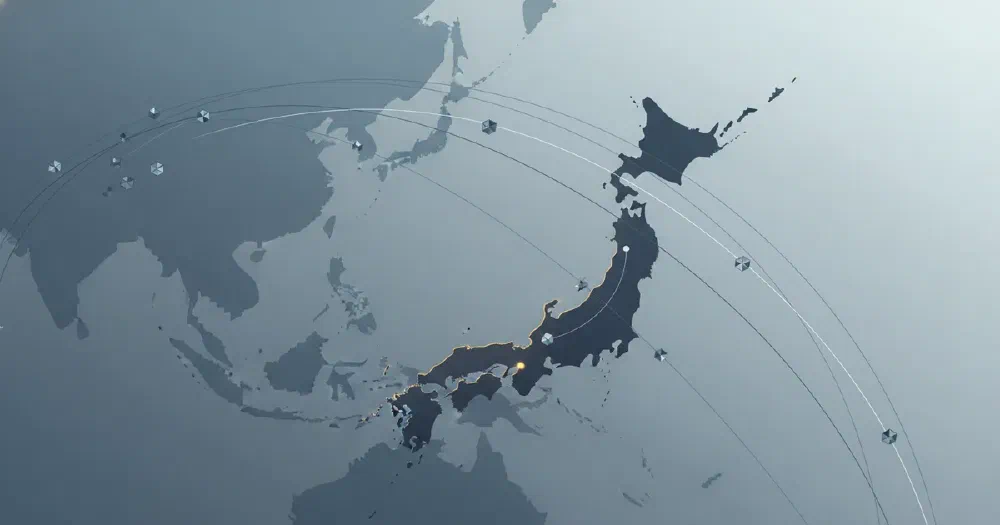
Japan sits at the northeastern edge of the East China Sea, an archipelagic state whose island chain forms the geographic lock on China’s access to the open Pacific. This position is simultaneously Japan’s greatest strategic asset and its most dangerous liability – indispensable to Western Pacific defense, yet exposed to missile saturation from arsenals mere minutes away. The 4th Basic Plan is Japan’s answer to a question that geography made inevitable: how does a constitutional democracy with pacifist norms build the military capability its position demands?
Context and Strategic Question
Japan adopted its 4th Basic Plan for Space Policy, placing security as JAXA’s explicit first priority for the first time in the agency’s history. This was not an isolated decision. It followed the 2022 National Security Strategy that committed Japan to defense spending approaching 2% of GDP, the acceptance of a counter-strike doctrine requiring space-based targeting, and the renaming of the Air Self-Defense Force to the Air and Space Self-Defense Force. Prime Minister Sanae Takaichi, who took office in late 2024, has gone further than any predecessor, explicitly stating that Japan’s military could intervene if China acts against Taiwan .
The strategic question is whether this reorientation produces genuine autonomous capacity or deeper dependency on the US alliance architecture. The principal actors are Japan, navigating remilitarization within constitutional constraints; the United States, as alliance anchor and potential constraint on Japanese autonomy; China, as the proximate threat driving the entire transformation; and India, as an emerging space-security partner whose trajectory increasingly converges with Japan’s.
The Geographic Foundations
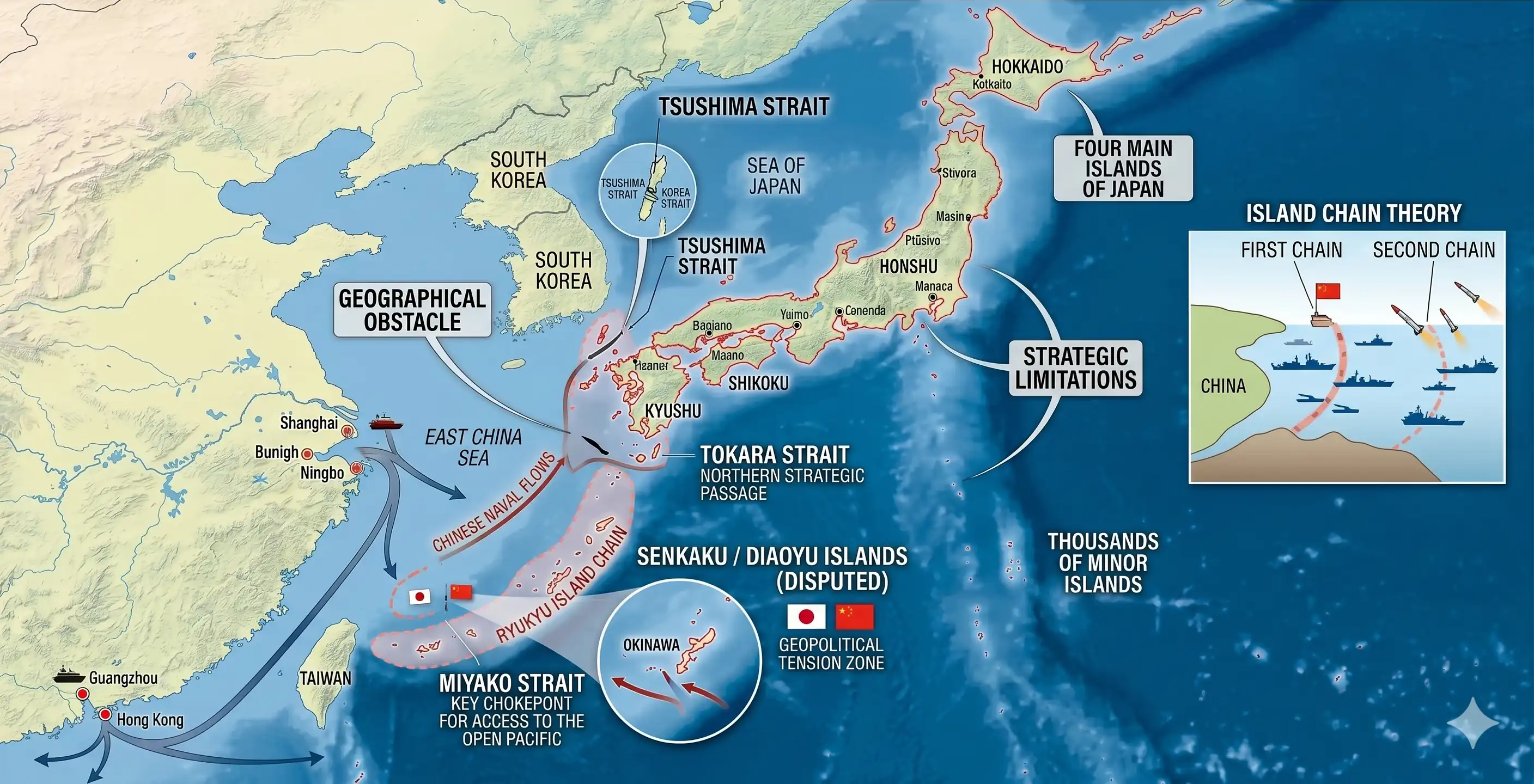
The most important geographic asset is this First Island Chain position. Japan’s archipelago is not merely adjacent to the containment line – it is the containment line. Every strategic framework confirms this: Japan anchors the northeastern flank of any architecture designed to prevent Chinese domination of the western Pacific.
The most critical vulnerability is energy dependence. A large share of Japan’s energy imports transit the South China Sea and Malacca Strait – sea lines of communication that Japan cannot defend alone. This structural dependency means that no amount of autonomous space capability eliminates the need for allied naval power to keep the energy arteries open.
Strategic Position Summary
| Lens | Position | Assessment | Key Insight |
|---|---|---|---|
| Mackinder (Heartland) | Outer Crescent | Maritime denial power facing the World-Island across narrow seas | Space-based ISR multiplies the geographic advantage of an Outer Crescent state that cannot project into the Heartland but can deny access to the Pacific |
| Mahan (Sea Power) | Strong, with constraints | Strong maritime fundamentals constrained by demographic decline and normative restrictions | Every major space investment – ISRT, QZSS, SDA – maps directly onto Mahan’s elements of sea power extended into orbit |
| Spykman (Rimland) | Indispensable flank anchor | Northeastern anchor of US Rimland containment, analogous to Britain’s role on the western flank | US cannot abandon Japan without losing the Pacific; Japan cannot defend itself without the US – mutual dependency is structural |
| Waltz (Structural) | Regional great power in bipolar transition | Third-largest economy building toward third-largest defense budget by 2027 | Declining extended deterrence credibility pushes Japan toward self-help; space is the lowest-friction domain for a constitutional democracy |

The Analysis
Classical strategic logic treats geography as destiny. For Japan, the collision between an exceptional geographic position and severe constitutional constraints produces a strategic dilemma that no single theoretical lens can resolve. When Mahan’s maritime logic points toward maximizing independent sea power, Spykman’s Rimland framework insists that the flank anchor needs a hegemonic sponsor. When realist analysis identifies the structural pressure to arm, constructivist analysis reveals that the arming can only succeed if wrapped in the right normative packaging. These tensions are not analytical failures – they are the genuine dilemmas that Japan’s policymakers navigate daily.
Through the Classical Lenses
Japan is a maritime power by necessity, not choice. With much of its land area mountainous, minimal domestic energy resources, and no continental strategic depth, every strategic calculation points seaward – and increasingly, spaceward. Mahan’s framework illuminates why the 4th Basic Plan concentrates investment on maritime-enabling capabilities. The JPY 280 billion ISRT constellation , covering 3,000 kilometers in all directions, provides persistent surveillance of the chokepoints and maritime approaches where Japan’s geographic advantage is strongest. QZSS delivers GPS-independent navigation for maritime operations and the counter-strike doctrine’s standoff weapons. Space domain awareness, tracking over 27,000 objects , protects the orbital infrastructure on which naval operations increasingly depend. Japan is building a space architecture to support maritime denial – the rational strategy for an insular power that scores highly on geographic position and physical conformation but faces binding constraints on population and manpower.
Mackinder’s framework explains the broader logic. As an Outer Crescent state, Japan cannot project power into the Eurasian Heartland. But it can deny Heartland and Rimland powers access to the Pacific – and space-based ISR is the modern mechanism for that denial. China’s drive to become a maritime power requires transit through Japan-controlled chokepoints, inverting the traditional Heartland advantage. The orbital domain extends this inversion: Japan’s space sensors can monitor Chinese naval movements far beyond the range of terrestrial radar, transforming geographic position into persistent domain awareness.
Spykman’s Rimland perspective adds a crucial constraint. Japan is not a Rimland state itself but the indispensable flank anchor of the US-led Rimland containment architecture. This role makes Japan strategically irreplaceable to Washington – but it also means that Japanese autonomy is bounded by alliance logic. The historical parallel with West Germany is instructive. When Bonn rearmed within NATO after 1955, it built a Bundeswehr optimized for alliance integration, not independent operations. Japan’s 4th Basic Plan shows awareness of this trap: the QZSS investment in GPS-independent navigation deliberately creates autonomous capability that the Bundeswehr never possessed. QZSS functions within the alliance during normal operations, but it provides independent options if alliance credibility degrades. That structure is analogous to France’s Force de Frappe, which gave Paris autonomous deterrence without breaking the Atlantic alliance.
The French parallel extends further. CNES’s trajectory from civilian space agency to dual-use institution mirrors JAXA’s current transformation. France’s Diamant launcher was a direct derivative of military ballistic missile technology; Japan’s H3 serves an analogous sovereign-access function, ensuring Tokyo can reach orbit without American permission. The successful HTV-X1 launch validates this capability. Where the analogy reaches its limit is nuclear weapons: France achieved genuine strategic independence through the Force de Frappe, but Japan’s Three Non-Nuclear Principles foreclose this path. Space becomes the domain where Japan pursues the autonomy that nuclear weapons provide for France – PNT independence as the functional substitute for nuclear independence.
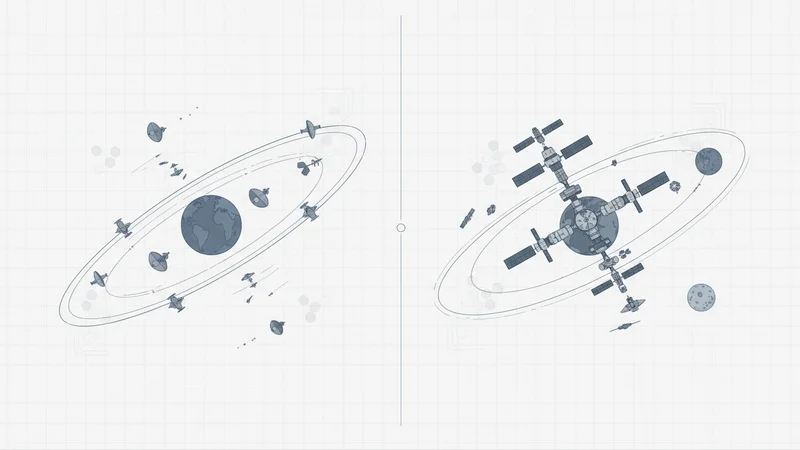
The game-theoretic structure of Japan’s ISR investment confirms why the program faces no serious domestic opposition despite its JPY 280 billion scale. Building the ISRT constellation is a dominant strategy – it improves Japan’s position regardless of Chinese behavior. If China accelerates its Taiwan timeline, Japan needs the surveillance capability to survive the contingency. If China maintains the status quo, the constellation deters future coercion by raising the cost of any Chinese adventurism. This Prisoner’s Dilemma structure means that the investment is rational even in a world where the threat never materializes, because its existence alters Beijing’s calculations.
The Artemis program and cislunar positioning operate through different strategic logic – a coordination game with network effects. As the Artemis Accords reach 61 signatories , the value of membership increases for every participant. Japan’s pressurized lunar rover contribution, the largest allied hardware investment in the Gateway architecture, serves simultaneously as cooperative contribution and coalition-reinforcing commitment. The sunk costs and identity commitments make Japanese defection from Artemis incredible, which in turn strengthens the framework’s gravitational pull on non-aligned states weighing Artemis against China’s International Lunar Research Station .
The Structural Position
At the system level, Japan occupies a position shaped by transitional polarity. The shift from American unipolarity toward US-China bipolarity creates structural pressure for middle powers to build independent capability – the declining credibility of extended deterrence under nuclear parity pushes allies toward self-help. Japan’s response follows the structural prediction: it is arming, but in the domain with the least friction.
The state-level dynamics explain why space is that domain. Article 9 of the Japanese constitution formally renounces war potential, but successive reinterpretations – collective self-defense in 2014, counter-strike doctrine in 2022 – have progressively expanded military scope without formal amendment. Space militarization fits within this accommodation pattern because orbital capabilities appear less provocative than kinetic forces. The technology-security state identity that constructivist analysis identifies is load-bearing here: JAXA’s restructuring , the Space Strategy Fund of approximately JPY 1 trillion, and the SLIM precision lunar landing are all framed as innovation and technology advancement, not military power. This framing is the normative mechanism that sustains the political coalition for rearmament. Without it, the domestic legitimacy for the 4th Basic Plan’s security-first orientation would erode.
The institutional restructuring functions as a costly commitment mechanism that game theory predicts should enhance credibility. JAXA’s reorganization, the Air and Space Self-Defense Force renaming, and the doctrinal acceptance of counter-strike capability are harder to reverse than budget allocations. They signal two things at once: to the United States, that Japan is serious about its defense contribution; to China, that the security investment is locked in regardless of which government holds power in Tokyo. The record FY2026 defense budget of 9.04 trillion yen , the twelfth consecutive record high, reinforces this signal. The historical pattern is suggestive rather than settled: no comparable case of a dual-use space agency transformation being reversed exists in the available record, though the number of comparable cases is small.
Yet domestic friction persists. The Science Council of Japan’s resistance to defense research , though moderating since 2022, represents the residual institutional power of the peace state identity. Japan’s ranking of 32nd globally in digital competitiveness constitutes a binding constraint on the ISR-to-decision chain – sensors without AI-enabled processing and data fusion produce surveillance without decision advantage.
Where the Theories Converge – and Where They Don’t
Every framework applied here agrees on one point, though Mahan, Mackinder, Spykman, and Waltz share overlapping realist premises rather than offering fully independent tests: space militarization is the structurally rational, normatively accommodated, and institutionally irreversible path for Japanese rearmament. Mahan identifies the geographic logic – a maritime power extending sea control into orbit. Mackinder confirms the domain – an Outer Crescent state that cannot project continentally but can deny Pacific access. The constructivist lens explains the mechanism – the technology-security identity that avoids direct confrontation with pacifist norms. Game theory validates the investment logic – ISR as dominant strategy regardless of Chinese behavior. Historical analogy leans toward permanence – no comparable case of reversal exists, though the sample of cases is small.
Where the frameworks diverge reveals genuine strategic dilemmas. Mahan’s logic suggests Japan’s geographic indispensability to the maritime hegemon guarantees alliance reliability – Washington cannot abandon the northern anchor of the First Island Chain. Waltz’s structural analysis counters that shifting polarity could redirect American attention, particularly if domestic politics or competing commitments in Europe erode the Pacific focus. The finding that Japan developed ISR capabilities “mostly in isolation” from US systems may be an early symptom of this divergence.
Mackinder’s Outer Crescent logic implies Japan should maximize autonomous action to preserve freedom if the geopolitical configuration shifts. Spykman’s Rimland logic implies the opposite: maximize integration with the offshore balancer, because the Rimland contest is what determines security outcomes. Japan’s dual-track strategy – autonomous QZSS alongside integrated Artemis – attempts to satisfy both, but resource constraints will eventually force prioritization.
The dominant framework for this case is Mahan’s Sea Power analysis. The 4th Basic Plan is fundamentally about leveraging maritime-geographic advantage through aerospace capabilities. Every major investment maps onto Mahan’s elements extended into orbit. Japan is building a space architecture to support maritime denial – and Mahan explains why this is the rational choice for an insular power with Japan’s geographic endowment, constrained population, and irreducible dependence on open sea lanes.

The Outlook
The structural analysis reveals a Japan that has made its strategic choice – not through a single dramatic decision, but through an accumulation of institutional, doctrinal, and fiscal commitments that collectively constitute an irreversible reorientation. The question is no longer whether Japan will militarize space, but whether the specific architecture it is building will produce the strategic outcomes it needs.
Strategic Implications
For Japan, the most urgent priority is closing the ISR interoperability gap before domain-differentiated autonomy hardens into structural isolation. The model of autonomous capability in some domains and allied integration in others only works if the domains are coordinated. The planned QZSS expansion from 7 to 11 satellites represents the most consequential autonomy investment – GPS-independent positioning, navigation, and timing has utility across every military domain and hedges against both alliance degradation and Chinese electronic warfare.
For the United States, Japan’s autonomous capability-building strengthens rather than weakens the alliance. The French historical precedent demonstrates that a degree of allied autonomy reduces free-rider dynamics and increases collective capability. Attempting to constrain Japanese ISR independence risks driving development further into isolation. The strategic priority should be integrating Japanese ISRT data into combined targeting architectures before the systems reach operational maturity in the 2030s – a gap that CSIS’s analysis of US-Japan tactically responsive space cooperation identifies as a near-term priority.
For China, the institutional lock-in means the security reorientation is not reversible through engagement, economic pressure, or political change in Tokyo. The 2025-2032 transition window is the period of greatest instability – Japan’s capabilities are funded and committed but not yet operational, creating dynamics that could incentivize preemptive action if Beijing misreads the trajectory. Japan’s costly institutional signals are designed to close this window by demonstrating irreversibility.
For India and Indo-Pacific partners, the convergence of Japanese and Indian space-security trajectories – lunar cooperation, complementary regional PNT systems, parallel civilian-to-dual-use agency transformations – offers the most promising avenue for reducing collective dependency on any single alliance architecture. The Japan-India space axis may become the most consequential bilateral space-security relationship in the Indo-Pacific outside the US-Japan alliance itself.
Limitations
Classical geopolitical frameworks – Mackinder, Mahan, Spykman – were designed for terrestrial geography. Their extension to the orbital domain requires analogical translation that is illuminating but imprecise. Chinese strategic intentions regarding the Taiwan timeline remain fundamentally opaque from open sources; the assessment of closing-window dynamics rests on assumptions about Beijing’s risk calculus that cannot be empirically verified. The analysis assumes continued policy continuity in Tokyo, sustained Chinese military expansion, and US commitment to the Indo-Pacific at broadly current levels. Excluded factors include cyber capabilities, economic interdependence as a conflict constraint, North Korean missile threats as a competing demand on Japanese defense resources, and the fiscal sustainability of defense spending under demographic decline. The structural analysis is most robust for the medium term of five to fifteen years; beyond 2035, demographic, technological, and polarity uncertainties compound significantly. The JPY 280 billion ISRT constellation figure traces to a single analyst source and is weighted accordingly. The claim that Japan developed ISR capabilities “mostly in isolation” from US systems is also single-sourced and sits in tension with the cooperation evidence documented elsewhere in this analysis (the SSA partnership and Space Operations Group); the isolation appears domain-specific to ISR/ISRT rather than characteristic of the alliance as a whole.
Primary Sources & Research
JAXA (2024). JAXA Sustainability Report 2024. JAXA. https://global.jaxa.jp/about/iso/pdf/JAXA_2024_e.pdf
JAXA (2025). JAXA Organization Chart (November 2025). JAXA. https://global.jaxa.jp/about/org/pdf/org_e_20251101.pdf
JAXA (2025). QZS-6 Launch and QZSS Constellation Update. JAXA. https://global.jaxa.jp/press/2025/01/20250130-1_e.html
JAXA (2025). HTV-X1 Cargo Spacecraft Launch Aboard H3 F7. JAXA. https://global.jaxa.jp/press/2025/10/20251023-1_e.html
Government of Japan (2024). Protecting Space Security. JapanGov. https://www.japan.go.jp/kizuna/2024/08/protecting_space_security.html
NASA (2026). Artemis Accords. NASA. https://nasa.gov/artemis-accords
Baldauff, L. (2025). Japan Space Security and Defense Buildup: Perspectives from Recent Strategies. ISPI. https://www.ispionline.it/en/publication/japan-space-security-and-defense-buildup-perspectives-from-recent-strategies-218125
Wilson, S. (2025). Next Steps for the US-Japan Space Alliance. CSIS. https://csis.org/analysis/next-steps-us-japan-space-alliance
Matsuo, H. (2024). Unaddressed Challenges in Defense Policy Reform in Japan. CSIS. https://csis.org/analysis/unaddressed-challenges-defense-policy-reform-japan
Rimland, B. (2024). US-Japan Cooperation on Tactically Responsive Space: Near-Term Capability and Long-Term Vision. CSIS. https://csis.org/analysis/us-japan-cooperation-tactically-responsive-space-near-term-capability-and-long-term
Saitou, Y. (2025). Japan’s Science Council Reform Deepens Academic-Government Rift. East Asia Forum. https://eastasiaforum.org/2025/09/26/japans-science-council-reform-deepens-academic-government-rift/
Joshi, M. (2025). Japan’s Rearmament: Technology, Deterrence, and Alliance Dependence. Observer Research Foundation. https://www.orfonline.org/expert-speak/japan-s-rearmament-technology-deterrence-and-alliance-dependence
The Diplomat (2025). China and India’s National Strategy and Competition in Cislunar Space. The Diplomat. https://thediplomat.com/2025/12/china-and-indias-national-strategy-and-competition-in-cislunar-space/
Al Jazeera (2025). Japan, China Continue to Spar at UN over Takaichi Remarks on Taiwan. Al Jazeera. https://www.aljazeera.com/news/2025/12/5/japan-china-continue-to-spar-at-un-over-takaichi-remarks-on-taiwan