
 spacestrategies.org

Why Italy’s space agency requires a structural reading
ASI is the third-largest contributor to the European Space Agency, presides over the ESA Ministerial Council for the 2025-2028 triennium, and yet is coordinated by a perimeter of seven distinct Italian state actors for a single launcher negotiation — a combination no other Quartet agency exhibits.
Italy pledged EUR 3.5 billion at the Bremen Ministerial on 25 November 2025, a +13% increase over Paris 2022. Minister Adolfo Urso took the ESA Ministerial chair for the 2025-2028 triennium, with the next Council set to be hosted in Italy in 2028. At the same time the country approved its first organic Space Economy law (Law 89/2025), transferred operational ownership of the IRIDE Earth-observation constellation to ASI, brokered the Launcher Exploitation Declaration that released Avio from Arianespace’s single-operator monopoly, and committed EUR 130 million to a lunar habitation module for NASA’s Artemis programme. Read as a line of headlines these facts describe an ambitious European power. Read as the output of a single institution they describe something stranger: an agency whose organisational form was designed for one role and is now being asked to perform another. A structural reading is the right way to see why.

What ASI is made of, and what it is for
For an agency of ASI’s kind the analytical weight sits almost entirely in the Formal and Efficient columns, with a centre of gravity at the Supersystem layer where governance is written and where the Quartet hierarchy is contested.
ASI owns very few spacecraft directly and builds almost nothing in-house. Unlike CNES, with its internal engineering directorates, or DLR, with its research-centre model, it relies on a triangle of INAF, INFN and national primes for mission execution. The Material dimension therefore reads through borrowed assets: the constellations and payloads that carry an ASI logo but a distributed industrial genealogy. The Final dimension is thicker than it first appears. The agency’s mission has been rewritten three times in two years — by Law 89/2025, by the December 2024 COMINT tasking, and by the IRIDE ownership transfer — and the declared purpose no longer matches the revealed purpose cleanly. That mismatch surfaces twice: in the Frame section here, and again in the Integration section at the end. The body sections between them document the anatomy cell by cell.
Assets & Technologies (Material Dimension)
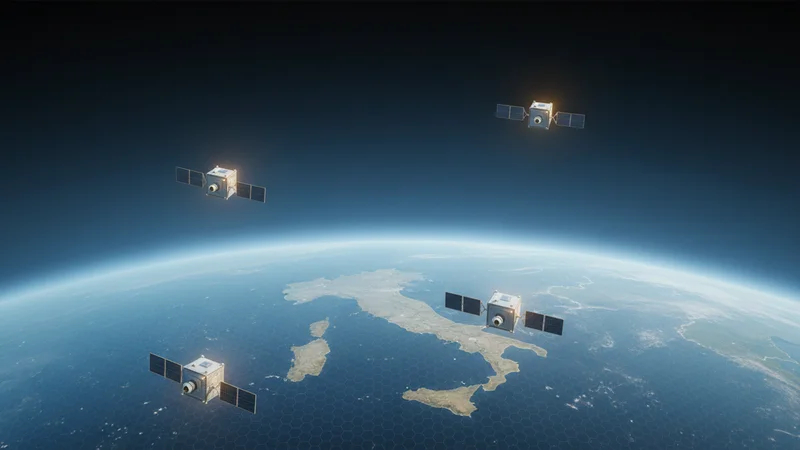
ASI’s material base is a network of spacecraft, ground stations and payloads whose distinguishing feature is that most of them are not owned by ASI — until, recently and deliberately, some of them started to be.
Foundational Layer
The Mediterranean equatorial reach of the Luigi Broglio Space Centre at Malindi, the low-latitude geometry of the Sardinia Deep Space Antenna near Cagliari, and the geodetic baseline of the Centro di Geodesia Spaziale at Matera are the three non-negotiable physical givens on which the Italian space infrastructure stands. These are substrates in the strict sense: they were chosen because of orbital mechanics and Earth geometry, not because of policy, and none of them can be relocated. Beyond them, ASI depends on the same spectrum, radiation environment and debris population as every other space actor — constraining but unremarkable.
Subsystem Layer
At the component level ASI’s inventory is dominated by instrument-class hardware produced by a recognisable cluster of national industrial actors. Thales Alenia Space Italia delivers the LETO and LEM-X payloads for the PNRR-funded Earth-Moon-Mars lunar programme . OHB Italia is prime for the Eaglet II octet that took IRIDE past sixteen on-orbit satellites on 28 November 2025, with a consortium of Optec and Aresys contributing the optical and SAR payloads. Qascom, a small enterprise in Bassano del Grappa, built the LuGRE receiver that on 2 March 2025 became the first GNSS device to acquire a fix on the lunar surface, landing aboard Firefly’s Blue Ghost. The IXPE focal-plane polarimeter developed at INAF-IAPS is the emblematic subsystem-level Italian contribution to a NASA Small Explorer. Together these items describe a component base that is deep in instruments and payloads.
System Layer
The integrated platforms that define ASI as a material presence are COSMO-SkyMed Second Generation, PRISMA, PLATiNO and — increasingly — IRIDE. CSG-FM3 was launched from Vandenberg on 28 December 2025, continuing the X-band SAR constellation under a dual civil-military ownership that remains the cleanest dual-use governance example in the Quartet. PRISMA carries the hyperspectral mission that has crossed the threshold from novel platform to baseline infrastructure for European machine-learning EO research. IRIDE is the largest system-level change in the agency’s material footprint. Sixty-eight satellites across six sub-constellations are targeted by 2027, assembled from five distinct technology lines rather than a single monolithic bus. Since the March 2026 Mission Data Policy, the constellation has operated under an ASI-issued data licence from mission control in Rome. It crossed into operations on 1 July 2026, when ASI opened the IRIDE Marketplace to the first satellite data and geospatial products — having already reached the PNRR-mandated twenty-four-satellite target seven months ahead of schedule.
Supersystem Layer
At the network scale, ASI’s material presence is always composite. IRIDE is conceived as a European EO layer complementary to Copernicus, not a substitute for it. The COSMO-SkyMed family is woven into SIASGE with Argentina’s SAOCOM constellation. Artemis contributions — the I-HAB pressurised module, the ESPRIT refuelling element, the candidate Lunar Surface Multi-Purpose Habitation Module — are by definition parts of a NASA-led architecture. The planned national LEO sovereign constellation, whose feasibility study COMINT ordered in December 2024, has since moved into a second study phase sized around a hundred satellites and a five-year-plus build. It remains a study rather than a funded programme. The European IRIS2 secure connectivity constellation in which Italy participates, meanwhile, is running behind schedule. The pattern is consistent across every case above: ASI contributes visible Italian hardware to networks whose governance sits somewhere else.
Architecture & Frameworks (Formal Dimension)
ASI diverges most sharply from its Quartet peers in its Formal architecture: its governing law, its supervisory chain, and its interministerial coordination machinery together describe an institution unlike CNES, DLR or UKSA in any of its three defining layers.
Foundational Layer
ASI was reconstituted as a Public Research Body (Ente Pubblico di Ricerca, EPR) under Legislative Decree 128/2003, a status it shares with INAF, INFN and CNR. None of the other Quartet agencies holds it: CNES is an EPIC under the Ministry of Research and Defence , DLR a registered association under BMWK tutelle, and UKSA an executive agency of the Department for Science, Innovation and Technology. The EPR status binds ASI’s personnel regime, its financial cycle and its accountability chain to the research-body framework. That is why MUR retains formal supervisory authority, even though strategic direction now flows through a political route the 2003 decree did not anticipate. This is the constitutional substrate on which every other formal feature rests.
Subsystem Layer
Component-level frameworks include the standard ECSS specifications, the IRIDE Mission Data Policy approved on 9 March 2026, the cybersecurity framework that anchors the ASI-State Police cybercrime convention renewed in March 2026 , and the body of qualification procedures that govern the COSMO-SkyMed and PRISMA ground segments. This subsystem cell also holds the software that flies on Italian payloads, the on-ground processing chains for hyperspectral and SAR products, and the mission-data licensing rules for IRIDE.
System Layer
The system-level framework is the Launcher Exploitation Declaration signed at the ESA Council on 10 July 2025. LED recognises Avio as the autonomous launch-service provider for the Vega family , ending the single-operator role of Arianespace. It also lets Avio obtain a Kourou operator licence — the first non-French entity France has accepted for launches from the Guiana Space Centre. Around the LED sits ASI’s project-governance apparatus for Artemis contributions, for the EMM lunar programme under PNRR funding, and for the dual-use CSG/Defence operational chain. The system-level framework is notably dense in procurement rules, which ESPI’s January 2026 One Word, Many Approaches report identifies as the most heterogeneous point of divergence across the Quartet.
Supersystem Layer
Here sit the two formal facts that make ASI structurally distinctive. The first is Law 89/2025 (Legge 13 giugno 2025 n. 89), Italy’s first organic Space Economy law. It was enacted after a Chamber vote of 133-89-2 on 6 March 2025 and designates ASI as the national technical authority for authorisation of private space activities. It is the first comprehensive national framework of its kind in the EU — a first-mover position that ESPI’s Bold Words, Blurred Lines brief warns may be overtaken by the forthcoming EU Space Act. The second is the Comitato Interministeriale per le Politiche relative allo Spazio e alla Ricerca Aerospaziale (COMINT), chaired by the Presidency of the Council of Ministers with MIMIT’s Minister Urso as delegated authority. COMINT allocates the envelope and sets direction while ASI executes. In May 2026 it formalised that role into a ten-year roadmap, the Documento Strategico di Politica Spaziale Nazionale . CNES operates under a single tutelle shared between the Ministry of Research and the Ministry of the Armed Forces. DLR reports to a single Bundesministerium. ASI’s arrangement is more fragmented still: its strategic direction runs through COMINT, its supervisory authority through MUR, and its industrial-policy interface through MIMIT, with a further space-policy office at the Presidency of the Council itself. The Italian architecture is the only one in the Quartet in which the political layer and the technical layer are institutionally separate.

Operators & Stakeholders (Efficient Dimension)
ASI’s distinguishing feature at the actor level is that it integrates rather than builds, and that its integrating function is itself spread across a perimeter of Italian state actors, academic execution arms, and a roughly three-hundred-firm industrial base.
Foundational Layer
The foundation builders that make ASI possible are the Italian research and educational institutions whose mandates predate the agency: INAF for astrophysics, INFN for particle and gravitational physics, CNR for broader technical research, and universities including Politecnico di Milano, Politecnico di Torino, Sapienza and Tor Vergata in Rome. Internationally, the standards and regulatory bodies — ITU, the Inter-Agency Space Debris Coordination Committee, COSPAR, ESA’s Concurrent Design Facility community — form the second foundation layer on which ASI relies. None of these is ASI’s creation; all of them are preconditions for its existence.
Subsystem Layer
The people who actually make Italian space hardware work for a cluster of primes, mid-caps and SMEs whose contours are now well documented: Leonardo, Thales Alenia Space and Telespazio as the historical trio; Avio as the launcher champion; OHB Italia as a more recent constellation prime; D-Orbit, SITAEL, Argotec and Qascom as the visible face of the Italian NewSpace layer. The Space Intel Report presentation delivered at IAC in October 2025 counted roughly three hundred Italian space companies and eight thousand employees, with five Business Incubation Centres co-managed by ASI and ESA. That is a base comparable in firm count to the German ecosystem, but with a different structural profile: heavier on mid-cap systems integration, lighter on propulsion-stage launcher startups. ESPI’s October 2025 Talent Report finds a sustained mid-level workforce shortage that the CM2025 demand surge is expected to aggravate, and which the Italian Space Factories pipeline and PNRR deadlines will feel directly.
System Layer
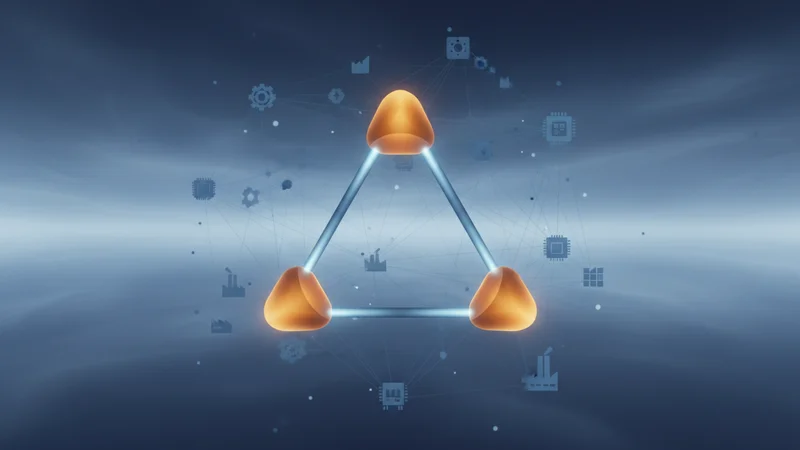
At the system level the primary integrator is ASI itself — but the integration is executed through a triangle of ASI, INAF and INFN that has no direct counterpart in the Quartet. The AGILE gamma-ray mission , which operated for roughly seventeen years between April 2007 and January 2024, is the textbook example. It was a flagship ASI programme run jointly with INAF, INFN, Italian universities and national industry, without an in-house ASI engineering team of the kind CNES maintains at Toulouse or DLR at Oberpfaffenhofen. A parallel execution triangle is visible in the Gamma-Flash programme for terrestrial gamma-ray flash detection, funded by ASI and led by INAF. The President of ASI and the Director-General sit at the apex of this triangle rather than at the head of a conventional technical directorate.
Supersystem Layer
The ecosystem coordinators for ASI include NASA (through the Artemis memorandum and the IXPE precedent), ESA (in which Italy is both the chair for 2025-2028 and the third-largest contributor), the European Commission (via IRIS2 participation and the forthcoming EU Space Act), and a growing set of domestic state actors whose overlap with ASI is itself an object of governance. MIMIT holds the space-economy portfolio and signed a “Space and Blue” inter-domain convention with ASI in December 2024. The Italian Defence Ministry is the co-operator of COSMO-SkyMed under a dual-use agreement. SACE and the Italian Trade Agency provide export insurance and market access. SACE covered up to 80% of the USD 290 million Thales Alenia-Bangabandhu-2 deal in July 2024, and ASI jointly launched the SPACE IT UP Vertical Acceleration Programme with ITA’s Houston office. ASI’s renewed convention with the State Police for cybercrime cooperation, signed in March 2026, extends the stakeholder map into a domain that CNES routes through the DGA and that DLR leaves to BMVg and the Bundeswehr Space Command. The LED negotiation itself required seven actors at the Italian table — PCM, MIMIT, the Office for Space Policies, the Military Adviser’s Office, MAECI, the Permanent Representation in Paris, MEF — with ASI as the technical chair.
Mission & Purposes (Final Dimension)
ASI’s declared purpose has been rewritten three times in two years, and the revealed purpose — visible through the IRIDE transfer, the LED, the Bremen pledge and the Artemis commitment — no longer aligns with the research-body mandate the 2003 decree inscribed in its foundations.
Foundational Layer
At the commons level ASI is still formally a Public Research Body: its civilizational register is fundamental understanding, peaceful use, equitable scientific access and the training of the next generation of researchers and engineers. This is what the 2003 decree says it is for, and it remains true — the scientific output of the AGILE mission, the IXPE detector, Gamma-Flash and the lunar PNT demonstration with LuGRE all fit this mandate squarely. The Foundational layer of purpose has not been erased; it has been overlaid.
Subsystem Layer
At the functional-performance level the objectives are the usual ones: reliability of the COSMO-SkyMed SAR data, integrity of the PRISMA hyperspectral products, qualification of the Vega-C upper stages, quality of the ground-segment timing and the mission-data licensing framework that the IRIDE Mission Data Policy formalises. These are unsurprising and well executed. ASI’s purpose is least contested at the subsystem layer.
System Layer
The operational capabilities ASI now delivers are broader than its research-body mandate implied. Earth observation through COSMO-SkyMed Second Generation and PRISMA is a sovereign capability with a Defence ownership share. The LED created an Italian launch-service autonomy that is a sovereignty objective in the strict sense of the term. The March 2025 LuGRE lunar PNT demonstration, the March 2026 cybercrime convention with the State Police, the transfer of IRIDE in-orbit assets to direct ASI ownership in June 2026, and the Artemis habitation module commitment are all system-level capabilities whose purpose is not primarily scientific. ASI has become, de facto, an operator of Italian sovereign and dual-use infrastructure — the role that Valente’s own communique names when he declares that the agency is now “operator, not only coordinator”.
Supersystem Layer
At the civilizational and strategic level ASI has been given three simultaneous missions that a single research body would not normally be asked to hold together: a scientific mission inherited from the 2003 decree; an industrial-policy mission that runs through MIMIT, SACE and the PNRR; and a sovereign-capability mission that runs through COMINT, the Presidency of the Council and the Defence Ministry. Law 89/2025 adds to this a regulatory mission — designating ASI as the national technical authority for private space activities — whose stakes are complicated by the European Commission’s forthcoming EU Space Act. The Bremen pledge of EUR 3.5 billion and the Italian chairmanship of the ESA Ministerial Council are the most visible expressions of a strategic ambition that far exceeds the agency’s constitutional scope. The absence of any Italian contribution to the EUR 900 million European Launcher Challenge is the clearest signature of what that ambition chose not to include — Germany put in EUR 363 million, France EUR 179 million, Spain EUR 169 million and the UK EUR 144 million.
Integration: emergent properties
Read dimension by dimension, ASI looks like a mid-sized European research body with an ambitious international portfolio. Read across all sixteen cells simultaneously, three emergent properties appear that no single dimension would surface on its own.
The first is a mandate-reality gap at the Final/Supersystem cell that no formal act has yet resolved. The 2003 decree inscribed ASI as a Public Research Body. In practice, the Bremen pledge, the LED, the IRIDE ownership transfer, Law 89/2025 and the Artemis habitation module commitment inscribe it instead as a national technical authority, a sovereign operator, a regulatory gatekeeper and an export-industrial coordinator. These four additional roles do not fit inside the EPR constitutional envelope. This gap is the most structurally distinctive feature of ASI in the Quartet. CNES’s dual tutelle already anticipates sovereignty. DLR’s research-association form is routinely complemented by separate BMWK and BMVg chains. UKSA’s executive-agency status presumes a ministerial decision chain. ASI alone is being asked to perform as an operator from inside a research-body frame, and that mismatch is most visible at the Final/Supersystem cell.
The second is a governance bifurcation at the Efficient/Supersystem cell: the separation, unique in the Quartet, between the political layer (COMINT under PCM, MIMIT as delegated authority, MUR as supervisory authority, MAECI for external relations, MEF for the envelope) and the technical layer (ASI itself, with INAF and INFN as execution arms). The Launcher Exploitation Declaration required seven Italian actors around a single European decision. It delivered a breakthrough all the same: the end of Arianespace’s single-operator monopoly and Avio’s Kourou licence, an outcome that CNES could not have obtained and DLR would not have sought. The same bifurcation cuts both ways. It let Italy marshal a EUR 3.5 billion Bremen pledge with political speed, and it is also why Italy contributed nothing to the European Launcher Challenge: the political layer chose national-champion consolidation over diversified competition, while the technical layer had no separate voice with which to argue otherwise. The bifurcation is not a bug; it is how the system makes decisions.
The third emergent property is an execution-model signature at the Efficient/System cell that determines what ASI can and cannot do. The ASI-INAF-INFN triangle, with national primes as industrial executors, is the structurally distinctive way Italy runs flagship missions: an “integration by federation” model. It delivered seventeen years of AGILE operations, the IXPE focal-plane polarimeter, Gamma-Flash and LuGRE — all without an in-house engineering directorate of CNES or DLR size. The same model imposes a ceiling. It is well suited to instrument-class contributions within larger architectures (NASA-led Artemis, ESA-led Copernicus complements, multi-partner lunar missions), and less well suited to the autonomous large-scale platform programmes that the Final/Supersystem layer now describes as the agency’s revealed mission. The IRIDE ownership transfer in June 2026 is the first test case: it asks the ASI-INAF-INFN triangle to become a constellation operator, not only an instrument federation.
ASI is an institution whose constitutive architecture was designed for scientific federation and is now carrying a strategic and operational load for which that architecture was never specified.
The three emergent properties converge on a single picture. A constitutive architecture — the 2003 EPR frame, the MUR supervisory line, the ASI-INAF-INFN execution triangle — is being asked to carry a strategic load it was not designed for. That load includes sovereign EO and launch autonomy, a national regulatory role under Law 89/2025, an Artemis-class lunar contribution, and a chairing role inside the ESA Ministerial Council for a triennium in which the European agency itself is restructuring around a new Resilience, Navigation and Connectivity Directorate . The keystone partnerships that make this load bearable are the interministerial one with COMINT and the scientific-federation one with INAF and INFN. The load-bearing joint between them is the ASI presidency. This anatomy does not predict how the mismatch will be resolved: through constitutional reform of the agency, through a further thickening of the COMINT layer, or through a quiet migration of operational mandates to other state actors. What it does make clear is that the resolution, whatever form it takes, has to happen at the Final/Supersystem cell, because mandate and reality no longer coincide there.
Primary Sources & Research
ASI (2024). Comint: approvati gli indirizzi di Governo in materia spaziale e aerospaziale. ASI. https://www.asi.it/2024/12/comint-approvati-gli-indirizzi-di-governo-in-materia-spaziale-e-aerospaziale/
ASI (2025). Spazio: al via il Consiglio Ministeriale dell’ESA sotto la presidenza italiana di Urso. ASI. https://www.asi.it/2025/11/spazio-urso-domani-a-brema-dove-presiedera-il-consiglio-ministeriale-dellesa/
ASI (2025). Valente, presidente ASI: da oggi l’Italia ha un proprio fornitore di servizi di lancio. ASI. https://www.asi.it/2025/07/valente-presidente-asi-da-oggi-litalia-ha-un-proprio-fornitore-di-servizi-di-lancio/
ASI (2025). Stati Generali della Space Economy 2025. ASI. https://www.asi.it/2025/10/stati-generali-della-space-economy-conclusa-la-seconda-edizione-con-lagenzia-spaziale-italiana-protagonista-del-confronto-nazionale-sul-futuro-dello-spazio-italiano/
ASI (2026). Avanzano le attivita del Task 1100.2: Technology Readiness Level dei core payload. ASI. https://www.asi.it/2026/03/avanzano-le-attivita-del-task-1100-2-dedicate-allavanzamento-del-technology-readiness-level-dei-core-payload/
ASI (2024). Al via gli Stati Generali della Space Economy. ASI. https://www.asi.it/2024/09/al-via-gli-stati-generali-della-space-economy/
ESA (2025). ESA Member States commit to largest contributions at Ministerial. ESA. https://www.esa.int/About_Us/Corporate_news/ESA_Member_States_commit_to_largest_contributions_at_Ministerial
ESA (2026). Eight more satellites added to IRIDE space programme. ESA. https://www.esa.int/Applications/Observing_the_Earth/IRIDE/Eight_more_satellites_added_to_IRIDE_space_programme
ESA (2026). ESA budget 2025 — Directorate reassignment. ESA. https://www.esa.int/ESA_Multimedia/Images/2025/01/ESA_budget_2025
CNES (2025). Rapport d’activite 2024. CNES. https://cnes.fr/sites/default/files/2025-09/rapport-activite-cnes-2024.pdf
ESPI (2024). Trade & Export Credit Agencies, a Strategic Enabler in the Space Data Economy. ESPI Brief 70. https://www.espi.eu/briefs/brief-70/
ESPI (2024). The Draghi Report: A Missed Opportunity for Inclusiveness and Engagement of all European Actors in Space. ESPI Perspectives. https://www.espi.eu/perspectives/draghi-report/
ESPI (2025). Talent in the European Space Sector: Bridging Gaps, Building Futures. ESPI. https://www.espi.eu/reports/talent-in-the-european-space-sector-bridging-gaps-building-futures/
ESPI (2025). Bold Words, Blurred Lines: A Reflective Look at the EU Space Act. ESPI. https://www.espi.eu/reports
ESPI (2026). One Word, Many Approaches: A Transatlantic Look at Commercial Space Procurement. ESPI. https://www.espi.eu/reports
ORF (2024). Italy’s BRIexit: Not All Roads Lead to Beijing. ORF Occasional Paper No. 441. https://www.orfonline.org/research/italy-s-briexit-not-all-roads-lead-to-beijing
ORF (2025). Space geopolitics: Europe’s call for autonomy. Observer Research Foundation. https://www.orfonline.org/expert-speak/space-geopolitics-europe-s-call-for-autonomy
Pittori, C. et al. (2025). The AGILE space mission: an Italian success story and its legacy for future space astronomy. arXiv. https://arxiv.org/abs/2501.12970
Di Marco, A. et al. (2022). Calibration of the IXPE focal plane X-ray polarimeters to polarized radiation. arXiv. https://arxiv.org/abs/2206.07582
Bulgarelli, A. et al. (2023). The Gamma-Flash data acquisition system for observation of terrestrial gamma-ray flashes. arXiv. https://arxiv.org/abs/2302.08321