
 spacestrategies.org

Why Britain’s space agency requires a structural reading
UKSA does not itself hold the launch licences flown from its own spaceports. It does not itself hold the spectrum authority its own satellite operators depend on. And from 1 April 2026 it does not even hold its own departmental identity: the agency has been absorbed into the Department for Science, Innovation and Technology, keeping only its public-facing name .
Every function that ASI, CNES or DLR concentrate in-house is, in the UK, held by someone else. The Civil Aviation Authority, not UKSA, is “the regulator” under the Space Industry Act 2018, issuing launch, orbital-operator and spaceport licences. Ofcom, not UKSA, licenses satellite spectrum and represents the UK at the International Telecommunication Union. The Ministry of Defence, not UKSA, runs the £5 billion Skynet military satellite constellation and the National Space Operations Centre. UKSA’s own historical footprint has been a lean staff of roughly two hundred people , and its budget now sits inside a department that also funds UK Research and Innovation and the Met Office. Meanwhile the one relationship that survived Brexit intact, membership of the European Space Agency, remains the agency’s oldest and largest delivery channel, worth a further £1.7 billion pledged at the November 2025 Bremen Ministerial Council . An agency built this way is not a smaller version of its continental peers; it is a differently shaped organism, and the shape itself is the story.

What UKSA is made of, and what it is for
For an institution of this kind, the analytical weight sits overwhelmingly in the Formal and Efficient columns. UKSA is unusual even among institutions in how far the Efficient column’s weight spreads across the System layer rather than concentrating at Supersystem.
The Material dimension is thin: UKSA owns little hardware directly, and what physical presence the UK space enterprise has — Harwell’s ESA campus, Skynet’s satellites, the three nascent spaceports — belongs to other actors operating under UKSA’s coordination rather than its title. The Formal dimension is dense at every layer, because three separate statutes, a departmental merger and a bilateral technology-safeguards treaty all bear on what the agency can do. The Efficient dimension departs furthest from the standard institutional pattern. CAA, Ofcom and MOD are not merely external stakeholders at the Supersystem layer, as peer agencies or contractors would be; they are co-equal System-layer actors, each holding a statutory function that ASI, CNES and DLR retain in-house. That triple split, and what it costs and buys the UK, is the thread the Integration section below pulls together. A second thread runs alongside it: whether the UK’s most active and internationally visible space activity, spectrum regulation, is keeping pace with its actual launch and satellite delivery record.
Assets & Technologies (Material Dimension)
UKSA’s material base is borrowed, distributed, or run by someone else, and the clearest exception, the high-latitude geography of Scotland’s northern isles, was chosen for reasons of orbital mechanics rather than institutional design.
Foundational Layer
The physical substrate that most directly shapes the UK’s space geography is latitude. SaxaVord Spaceport on Unst, in Shetland, and Sutherland Spaceport on the Scottish mainland were sited for their access to polar and sun-synchronous orbits — a non-negotiable geometric fact rather than a policy choice. Beyond this, the UK’s material base depends on the same spectrum, orbital debris environment and radiation regime as every other space actor. That is unremarkable in itself, but load-bearing for the spectrum-licensing story told in the Formal dimension below.
Subsystem Layer
At the component level, the UK’s most visible recent hardware commitment is Airbus’s Future Protected Modem Type-A, delivered under an 18-year contract signed in November 2024 to replace the Paradigm Modem System across the Skynet fleet. The Skynet 6A satellite itself, contracted to Airbus in 2020 for more than £500 million, uses a Eurostar Neo platform assembled by Airbus in the UK and tested at RAL Space’s Harwell facility . On the commercial side, Open Cosmos built the Dover navigation-resilience satellite that flew, unsuccessfully, on the UK’s first orbital launch attempt in January 2023, alongside the first satellite built in Wales, from Space Forge. Vehicle-level hardware includes Orbex’s Prime rocket and Rocket Factory Augsburg’s vehicle, the latter now targeting a five-week SaxaVord launch window opening 10 August 2026 after successive delays.
System Layer
The integrated platforms that carry the UK’s material presence are Skynet 5 and the incoming Skynet 6A, due in service in 2026, run by Airbus for the MOD; the National Space Operations Centre, whose first full year of operation logged over 30,000 collision alerts, 870 tracked uncontrolled re-entries and more than 1,800 ballistic missile launches ; and ECSAT at Harwell, ESA’s roughly 170-staff UK site spanning seven ESA directorates including Connectivity and Secure Communications, hosting the Moonlight lunar-communications programme and a 5G/6G Hub. Three spaceports, Cornwall, SaxaVord and Sutherland, complete the system-level inventory, though as of mid-2026 none has yet delivered a successful orbital launch.
Supersystem Layer
At network scale, the UK’s material footprint is inseparable from equity rather than ownership. The government holds 10.89% of Eutelsat’s capital following a 2025 capital raise that channelled €90 million toward both OneWeb’s low-Earth-orbit constellation and the EU’s IRIS² secure-connectivity programme — a network the UK cannot formally join as a member state but now co-funds through its shareholding. That stake traces back to the UK’s original 2020 OneWeb rescue, where the government retained a “special share” preserving national-security veto rights, control over the company’s headquarters location, and preferred status for UK-industry manufacturing . By 2024, the same holding had also lost an estimated £200 million in value against its original outlay . The retained security and industrial rights and the financial loss are both independently reported and both true — one is no more a rebuttal of the other than a balance sheet cancels a veto. ESA’s Business Incubation Centre network, coordinated from ECSAT across four UK locations, has supported some 140 start-ups since 2010 . The pattern recurs: the UK’s largest material stakes in multi-platform space infrastructure typically run through equity or ESA participation rather than sole ownership.

Architecture & Frameworks (Formal Dimension)
UKSA diverges most sharply from ASI, CNES and DLR in the Formal dimension, because its constitutive status as an executive agency of a ministerial department — not a public research body or treaty-founded corporation — shapes every layer above it.
Foundational Layer
UKSA has been an executive agency of the Department for Science, Innovation and Technology. From 1 April 2026 it is formally merging into DSIT as a single unit for civil space strategy, policy and delivery, while retaining its public name. Three statutes frame all UK spaceflight activity: the Outer Space Act 1986 for extraterritorial UK-national activity, the Space Industry Act 2018 for UK-territory activity, and the Air Navigation (Amendment) Order 2021 for sub-stratosphere rockets. Section 2 of the SIA gives the Civil Aviation Authority, as “the regulator,” an overriding statutory duty to secure public safety, a duty explicitly stated to have primacy over all other matters. Crown bodies — including UKSA itself, the MOD, the Met Office and the Science and Technology Facilities Council — use spectrum under Crown immunity without an Ofcom licence , a foundational carve-out with no equivalent in a treaty-based agency’s constitution.
Subsystem Layer
Schedule 1 of the Space Industry Act lists 39 categories of licence conditions covering safety, training, insurance, security, environmental effects and international obligations — one of the most granular licensing schedules of its kind in primary legislation anywhere. Section 8 adds a national-security and “fit and proper” gate that every applicant must clear. Below the SIA, CAP 2209 sets out CAA licensing guidance. ISO 24330, the first formal international standard for satellite rendezvous and proximity operations, published in July 2022 from the industry-led CONFERS consortium , now anchors a UK regulatory sandbox. That sandbox pairs the DSIT-UKSA merger with more than sixty industry-designed recommendations for in-orbit servicing, developed by Astroscale, ClearSpace and D-Orbit with the CAA .
System Layer
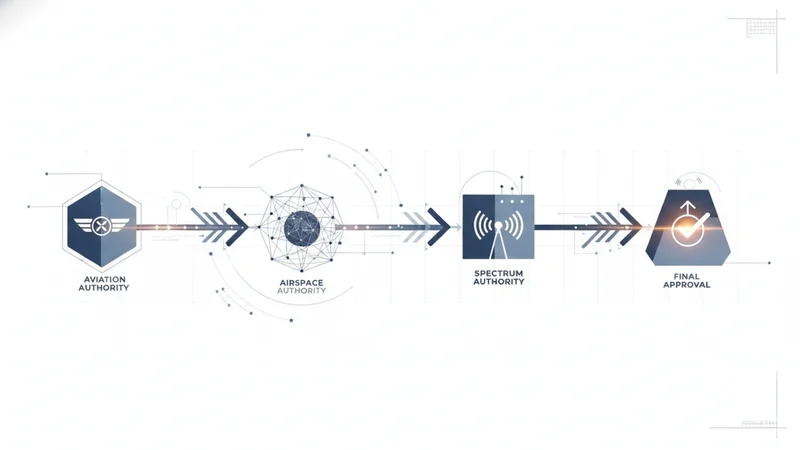
At system level, licensing runs through two entirely separate CAA tracks: the Space Regulator team, which issues launch and orbital-operator licences under the SIA, and the Airspace Regulation department, which runs the CAP1616 airspace-change process . That second track can take longer to clear than the space licence itself. Appeals against CAA decisions are formally provided for under SIA Schedule 10 and the Space Industry (Appeals) Regulations 2021 . UKSA’s own 2025-26 operating model organises this landscape into eight Themes and five cross-cutting Threads , one of which is dedicated entirely to the European Space Agency relationship.
Supersystem Layer
The most consequential Formal facts sit here. The DSIT-UKSA merger itself is a supersystem-level reorganisation, folding an agency into a department that already leads UK spectrum policy above both UKSA and Ofcom. A bilateral UK-US Technology Safeguards Agreement enables American launch technology at licensed UK sites, a direct substitute for institutional access the UK once had through EU frameworks. In June 2026 Ofcom proposed a three-to-five-year transition for Viasat and EchoStar’s 2 GHz mobile-satellite-service licences after May 2027 expiry, a domestic, market-led approach that diverges structurally from the EU’s parallel move toward a single centralised Union-level authorisation for the same band. That divergence follows the UK’s earlier revocation of its retained EU mobile-satellite-service decisions under the Radio Spectrum (EU Exit) Regulations 2018.
Operators & Stakeholders (Efficient Dimension)
UKSA’s defining feature at the actor level is that the functions a treaty-based peer agency would hold in-house are distributed across at least four co-equal institutions, none of which reports to another.
Foundational Layer
The regulators and standards bodies that make the UK system possible are the CAA, licensing spaceflight under the SIA; Ofcom, licensing spectrum and representing the UK at the ITU , including for British Overseas Territories, the Channel Islands and the Isle of Man; and the Science and Technology Facilities Council, UKSA’s separate research-council counterpart, with which UKSA coordinates strategy for space-science missions it does not itself fund or execute in-house.
Subsystem Layer
The people and firms that build UK space hardware include Airbus, contracted for both the Skynet 6A satellite and the FPMA modem programme; RAL Space engineers at Harwell, who integrate and test UK-built satellite payloads; and the Astroscale, ClearSpace and D-Orbit consortium that co-designed the in-orbit servicing sandbox alongside the CAA. Airbus separately partners with KBR, Leidos UK, Northrop Grumman and QinetiQ on an “Open Innovation – Space” initiative intended to widen SME participation in UK military satellite communications.
System Layer
At system level sit the four actors whose statutory functions do not overlap: UKSA itself, historically a lean organisation of about two hundred people overseeing the entire civil sector; the CAA, as launch and orbital-operator regulator; Ofcom, as spectrum regulator; and the MOD, through UK Space Command and NSpOC, run entirely outside UKSA’s civil remit and self-described in a January 2026 government Command Paper as “the largest space organisation outside the US.” Around the launch sites, SaxaVord, Orbex, HyImpulse and Space Forge are the commercial operators whose CEOs gave direct testimony to the House of Commons in 2023 about the coordination costs of dealing with all four bodies at once.
Supersystem Layer
Above the system-level actors, DSIT is now the single department housing both space policy and spectrum policy, chairing the UK Spectrum Board that governs Crown-immune spectrum use. The MOD sits institutionally apart, and Gabriel Elefteriu, in a Policy Exchange assessment, attributes this separation to a structural Whitehall power differential favouring the MOD over the civil side in any cross-departmental coordination body. Rather than creating a dedicated Space Minister, as a House of Lords committee recommended, government instead established a cross-departmental Space Ministerial Forum. It also retained the existing Space Strategy and Delivery Board, jointly chaired by DSIT and MOD officials. ESA itself, the European Commission through Eutelsat’s IRIS² participation, the National Audit Office, and the trade association UKspace, whose president Alice Bunn has described UK funding as “spread very, very thinly across very many priorities,” complete the ecosystem-coordinator layer.
Mission & Purposes (Final Dimension)
UKSA’s declared mission, building sovereign launch and navigation capability while leading in space regulation, sits against a revealed pattern of chronic underfunding that government’s own messaging has repeatedly chosen to manage rather than acknowledge.
Foundational Layer
At the commons level, the CAA’s overriding statutory duty is public safety, stated to take primacy over all other regulatory considerations. Ofcom’s 2022 Space Spectrum Strategy commits to protecting Earth-observation and navigation spectrum from harmful interference and to supporting international space-debris-tracking efforts. These are the peaceful-use, safety-first purposes the UK system shares with any space actor, expressed through a civil-aviation-regulator model rather than an engineering agency’s mission-delivery ethos.
Subsystem Layer
At functional-performance level, an impact analysis of 44 projects funded through ESA’s General Support Technology Programme , covering 31% of 2019-2024 UK funding in the scheme, found an average 2.28 technology-readiness-level advancement, £24.6 million in additional revenue, and a 116% return on public investment. This is a concrete example — UKSA’s own accounting of its programme, not an independent audit — of the UK using ESA optional-programme subscriptions to secure demonstrable domestic returns.
System Layer
Operationally, the UK delivers real capability at this layer: NSpOC’s space-domain-awareness output, Ofcom’s rapid 2024-2026 sequence of NGSO and direct-to-device approvals for Amazon Kuiper, Starlink, and a joint Inmarsat/Space Norway network , and Skynet’s secure military communications, backed by £5 billion over ten years plus a further £1.4 billion for new defence-space technologies. Nearly 20% of UK GDP depends on satellite-enabled services, according to UKSA data , spanning financial transactions, navigation and emergency response, a figure that frames UK space policy as economic-resilience infrastructure rather than a narrow prestige budget line.
Supersystem Layer
At the strategic level, two framings of the same investment compete for the headline. Government cites a direct economic return of £7.49 for every £1 the UK invests in ESA . The National Audit Office separately found that UK firms receive only £0.93 in ESA contract value for every £1 UKSA contributes , excluding ESA’s own operating costs. The two figures measure different things — a macro-economic return against a direct industrial “juste retour.” Both circulate in UK space-policy discourse as competing answers to the same question of value for money. A similar tension surrounds the January 2023 Virgin Orbit launch. Government’s “National Space Strategy in Action” states the failed mission “secured UK leadership in European launch licensing, operation, and preparation.” The House of Commons Science, Innovation and Technology Committee, reporting the same month on named witness testimony from the affected operators, found the CAA “got off to a slow start” and recorded complaints about the absence of “a central clearing house” across statutory stakeholders. The 2021 National Space Strategy itself omitted any mention of the UK’s lost Copernicus contracts or its excluded Galileo access, prompting space-policy academic Dr Bleddyn Bowen’s public criticism that the strategy contained “no new funding.” physicist Brian Cox, citing an unpublished government audit and reported alongside a 2025/26 House of Lords committee session on the sector, put UK space investment at just 0.05% of GDP, materially below France and Italy . 60% of UK space firms turn over less than £260,000 a year, and only 1.6% have scaled meaningfully in a decade . That is a “valley of death” in scale-up financing, one the average UKSA grant, below £100,000 in 2023/24, does little to close.

Integration: emergent properties
Read dimension by dimension, UKSA looks like a modestly staffed coordinating agency inside a larger department. Read across all sixteen cells simultaneously, three emergent properties appear that no single dimension would surface on its own.
The first is a four-way authority split at the Efficient/System cell that has no direct counterpart among ASI, CNES or DLR. UKSA, the CAA, Ofcom and the MOD each hold a statutory function a treaty-based peer agency keeps in-house, and none reports to another. SaxaVord’s own approvals span the CAA, UKSA oversight and the Maritime and Coastguard Agency simultaneously. Virgin Orbit’s chief executive, Dan Hart , told Parliament in 2023 there was no “central clearing house” across the many statutory stakeholders a launch operator must satisfy. This is not an accident of history so much as a settled design choice. When a House of Lords committee recommended a dedicated Space Minister to concentrate accountability, government instead layered a further coordination forum, the Space Ministerial Forum, onto the existing DSIT-MOD Space Strategy and Delivery Board. The Whitehall power differential Policy Exchange’s Gabriel Elefteriu identifies, the sole assessment in the corpus naming this dynamic, means the MOD tends to dominate that body whenever civil and defence priorities collide. The split is real, load-bearing, and, on the evidence available, not going away with the DSIT merger.
The second is a readiness mismatch between the Formal/Supersystem cell and the Material/System cell. Ofcom’s spectrum decisions — the D2D approvals for VodafoneThree and O2, the Kuiper and Starlink gateway licences, the joint Inmarsat/Space Norway authorisation — arrived in a rapid sequence between 2024 and 2026. They represent the UK’s clearest, most internationally visible instance of regulatory entrepreneurship. Set against the physical delivery record, the picture is markedly slower: the UK’s first orbital launch attempt failed in January 2023; SaxaVord’s first test flight slipped from a planned late-2025 window into an August 2026 attempt after a 2024 test-stand explosion; Orbex, the ESA Boost!-funded vehicle developer behind Sutherland Spaceport, entered administration in 2026, leaving that site roughly two years behind SaxaVord. Licensing readiness, in other words, has consistently run ahead of commercial and technical delivery readiness. The gap is wide enough that it should temper any reading of Ofcom’s regulatory tempo as a proxy for the underlying industry’s maturity.
The third emergent property is a mandate-reality gap at the Final/Supersystem cell, visible whenever government’s declared framing of an investment or an event meets an independent assessment of the same fact. The £7.49-per-£1 ESA return government cites and the National Audit Office’s £0.93-per-£1 industrial “juste retour” measure different things, but both are marshalled in the same public debate. The 2023 Virgin Orbit failure was recast by government as having “secured UK leadership” in launch licensing the same month a parliamentary committee, working from the operators’ own testimony, found the regulator had “got off to a slow start.” The 2021 National Space Strategy said nothing about the Galileo and Copernicus losses that prompted its own writing. A 0.05%-of-GDP space-investment figure, put on the record alongside a 2025/26 House of Lords committee session, sits against a persistent “valley of death” in scale-up financing. None of these pairs is a factual contradiction in the strict sense; each is a case of declaratory ambition and independently audited reality sitting side by side without being reconciled in the same document.
UKSA is an institution whose formal authority was deliberately distributed across four other bodies, and whose engineering capacity was never built in-house to begin with. That makes its continuous ESA membership the single joint the whole anatomy depends on.
Together, the three properties describe an agency that competes on regulatory reach because it was never given, and never sought, the concentrated authority or in-house engineering capacity its continental peers hold — the split is that choice’s institutional form, the readiness gap its operational cost, and the mandate-reality gap how government has managed that cost in public messaging rather than resolved it in funding. The keystone that makes the whole arrangement viable is ESA membership itself, unaffected by Brexit because ESA sits outside EU treaty structures. Historically it absorbed more than 80% of UKSA’s budget in its founding years; it is still worth £2.8 billion in commitments through 2034/35, the ECSAT campus at Harwell, and the GSTP and Boost! programmes that fund UK industrial capability the agency does not fund alone. Even that keystone is contested: Gabriel Elefteriu , in a Policy Exchange assessment, judges the UK’s long-term ESA future “increasingly in doubt” given its disadvantaged “third country” standing. This anatomy does not predict whether the four-way authority split will be simplified, whether launch delivery will catch up with spectrum-licensing tempo, or whether the mandate-reality gap will close through new funding or further managed messaging. But it does make clear that the resolution has to run through the ESA relationship, because that is the one joint the rest of the structure cannot function without.
Sources and evidence strength for every figure above: see the Key Figures table at the end.
Key Figures — Sources & Evidence
The table below traces every load-bearing figure in this anatomy back to its source and states how strongly the research corpus supports it. “Single source” means the figure is directional, the best available public estimate, not a settled, independently confirmed number. The first three rows are the figures most often confused for one another.
| Figure | Value | Source | Evidence |
|---|---|---|---|
| ESA return-on-investment | £7.49 per £1 (government macro-economic figure) vs. £0.93 per £1 (NAO industrial “juste retour,” excl. ESA overhead) | Innovation News Network | conflict (see Mission & Purposes / Supersystem layer) |
| CM25 ESA funding commitment | £1.7bn pledged (Nov 2025 Bremen Ministerial); £2.8bn cumulative UK ESA commitment through 2034/35 | gov.uk | corroborated |
| OneWeb 2020 stake value | Government retained a “special share” and national-security rights (2020); ~£200m paper loss in value by 2024 | Advanced Television | conflict (see Assets & Technologies / Supersystem layer) |
| Skynet defence budget | £5bn over 10 years (core) plus £1.4bn for new defence-space technologies | gov.uk — Defence Space Strategy | corroborated |
| UK space investment share of GDP | 0.05% of GDP, per physicist Brian Cox citing an unpublished government audit (reported alongside a 2025/26 House of Lords committee session, not the committee’s own published finding) | EU-Startups | single source |
| UK GDP dependent on satellite services | Nearly 20% of UK GDP | Chatham House (citing UKSA data) | single source |
| GSTP programme return (self-reported, not audited) | 116% return on public investment; £24.6m additional revenue (44 projects, 31% of 2019-2024 funding) | gov.uk — GSTP impact analysis | single source |
| NSpOC first-year space-domain-awareness output | 30,000+ collision alerts; 870 tracked uncontrolled re-entries; 1,800+ ballistic missile launches tracked | gov.uk — Government response to House of Lords report (CP 1478) | single source |
| Whitehall MOD/civil power differential | One think-tank assessment attributes MOD’s dominance of cross-departmental space coordination to a structural Whitehall power imbalance | Policy Exchange | single source |
| UKspace funding-spread quote | UK space funding described as “spread very, very thinly across very many priorities” | Payload Space | single source, secondhand reporting |
| ESA share of UKSA budget, FY2013/14-2017/18 | More than 80% of UKSA’s total budget | CSPS/Aerospace Corporation | single source (high reliability: named authors citing UKSA’s own strategy document) |
Primary Sources & Research
UK Government (2021). National Space Strategy. gov.uk. https://www.gov.uk/government/publications/national-space-strategy/national-space-strategy
UK Government (2023). National Space Strategy in Action. gov.uk. https://www.gov.uk/government/publications/national-space-strategy-in-action/national-space-strategy-in-action
UK Government (2018). Space Industry Act 2018. legislation.gov.uk. https://www.legislation.gov.uk/ukpga/2018/5/contents
Civil Aviation Authority (n.d.). Legislation. CAA. https://www.caa.co.uk/space/about-the-space-team/legislation/
Ofcom (2022). Statement: Space Spectrum Strategy. Ofcom. https://www.ofcom.org.uk/spectrum/space-and-satellites/statement-space-spectrum-strategy
UK Space Agency (2025). UK Space Agency Corporate Plan 2025-26. gov.uk. https://www.gov.uk/government/publications/uk-space-agency-corporate-plan-2025-26/uk-space-agency-corporate-plan-2025-26
UK Government (2026). Government Response to the House of Lords UK Engagement with Space Committee Report (CP 1478). gov.uk. https://www.gov.uk/government/publications/government-response-to-the-house-of-lords-uk-engagement-with-space-committee-report-the-space-economy-act-now-or-lose-out/government-response-to-the-house-of-lords-uk-engagement-with-space-committee-report-the-space-economy-act-now-or-lose-out
UK Government / MOD (2022). Defence Space Strategy: Operationalising the Space Domain. gov.uk. https://www.gov.uk/government/publications/defence-space-strategy-operationalising-the-space-domain
European Space Agency (n.d.). Ten Ways ESA’s UK Site Boosts Europe’s Space Ambition. ESA. https://www.esa.int/Space_in_Member_States/United_Kingdom/Ten_ways_ESA_s_UK_site_boosts_Europe_s_space_ambition
UK Government (2025). Growth and Security at the Forefront in UK Funding Boost for European Space Agency. gov.uk. https://www.gov.uk/government/news/growth-and-security-at-the-forefront-in-uk-funding-boost-for-european-space-agency
National Audit Office (2024). National Space Strategy and the Role of the UK Space Agency. NAO. https://www.nao.org.uk/wp-content/uploads/2024/07/national-space-strategy-and-the-role-of-the-uk-space-agency.pdf
European Space Policy Institute (2022). The Urgent Need for Sustainable EU-UK Relations in Space. ESPI Executive Brief No. 58. https://www.espi.eu/briefs/the-urgent-need-for-sustainable-eu-uk-relations-in-space/
European Space Policy Institute (2022). Rising Opportunities in the Satellite Connectivity Market: Eutelsat and OneWeb Combination. ESPI Brief No. 60. https://www.espi.eu/wp-content/uploads/2022/12/ESPI-Brief-NO-60-Eutelsat-OneWeb-Combination__Final.pdf
Policy Exchange (n.d.). UK’s Defence Space Strategy in Context. Policy Exchange. https://policyexchange.org.uk/publication/uks-defence-space-strategy-in-context/
RUSI (2022). The UK Defence Space Strategy. RUSI. https://www.rusi.org/explore-our-research/publications/commentary/uk-defence-space-strategy
Chatham House (2025). The SDR Presents an Opportunity for the UK to Become a Leader in Space – If It Is Followed by Urgent Investment. Chatham House. https://www.chathamhouse.org/2025/06/sdr-presents-opportunity-uk-become-leader-space-if-it-followed-urgent-investment
Center for Space Policy and Strategy / The Aerospace Corporation (2019). What Will Brexit Mean for the UK Space Sector? CSPS. https://aerospace.org/sites/default/files/2019-06/Brexit_06122019_3.pdf
Beutler, F. et al. (2026). Illuminating the Physics of Cosmic Origin and Evolution: A UK Space Frontiers 2035 White Paper. arXiv. https://arxiv.org/abs/2601.16761