
 spacestrategies.org
Key Insight
Question. Is China’s counterspace threat better understood as an inventory of weapons, or as an operational chain, and does the prevailing “space Pearl Harbor” framing point analysts toward the right danger?
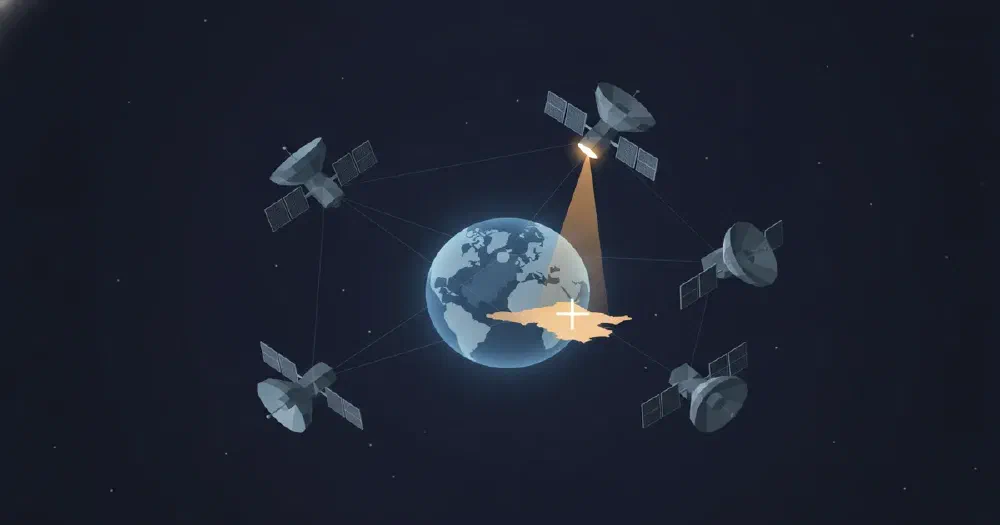
Thesis. Neither framing is quite right. The two highest-scored entries in this assessment are not two separate weapons. One is an ISR (Intelligence, Surveillance, and Reconnaissance) satellite constellation that has tripled since 2018. The other is a set of precision-strike kill chains that now credibly extend beyond the 400 to 600 kilometer range once assumed to bound PLA (People’s Liberation Army) reach from the mainland. Together they are sequential phases of a single maturing targeting chain. Both score 25 out of a possible 25 on this framework’s likelihood-impact-vulnerability scale — T9 and T10 in the risk matrix below (see “Risk Framework” in the Glossary at the end of the article). They are the only entries in the inventory to reach that ceiling, and both are still rising. Yet that convergence at the top of the inventory obscures the real danger. Neither Washington nor Beijing has declared what counterspace action against a strategic-warning satellite would cross a nuclear threshold. No bilateral hotline exists to clarify intent during a crisis. And the same commercial space sector feeding China’s ISR growth has already, by documented case, supplied satellite imagery to armed combatants in two active conflicts. Capability is growing steadily. The mechanisms that would contain a miscalculation are not growing at all.
Sources and evidence strength for every figure above: see the Key Figures table at the end.
State of the Art
China has never published an authoritative public counterspace doctrine. Its declaratory posture has instead been textually stable since roughly 2010: opposition to space weaponization, sponsorship, with Russia, of a draft treaty banning weapons in space, and “peaceful development” language, even as government white papers openly name national security as a program purpose. Demonstrated capability tells a fuller story than declaration does. Since the 2007 Fengyun-1C kinetic intercept , China has conducted repeated co-orbital rendezvous-and-proximity operations, including against its own geostationary satellites, deployed ground-based jamming equipment at Mischief Reef , demonstrated a robotic-arm servicing capability able to grapple and reposition a defunct satellite within days , and declared its emphasis toward reversible, debris-free “soft-kill” tools over destructive ones.
The institutional architecture producing these capabilities has itself been in transition since April 2024. That month, the Strategic Support Force, a 200,000 to 250,000-person organization, was dissolved. Its functions were redistributed into a new Aerospace Force, Cyberspace Force, and Information Support Force , all reporting directly to the Central Military Commission. A legal-institutional layer compounds both dimensions. Military-Civil Fusion gives Beijing compellable legal authority over nominally civilian space technology. That authority entangles a commercial sector of more than 400 firms with the counterspace and ISR mission set, in ways that have no close US analogue.

Complication
What makes this moment different is not a new weapon but a documented acceleration in reach. The Pentagon’s December 2025 China Military Power report assesses that China’s on-orbit ISR constellation has tripled since 2018. That figure comes from trade-press summaries of the report rather than the primary document itself, and it merits a cross-check before being cited as precise. Independently, peer-reviewed analysis in International Security finds that China’s long-range precision-strike kill chains already extend past the 400 to 600 kilometer mainland limit long assumed by planners. It describes this as “a serious and enduring challenge” — even while arguing that the broader military balance remains more manageable than many analysts fear. That single peer-reviewed source is the most contrarian, anti-alarmist voice in the underlying research base, and it does not dispute this particular finding. Meanwhile the organizational reshuffle that redistributed the old Strategic Support Force’s functions is still unsettled. Which missions sit with the Aerospace Force versus the Information Support Force remains genuinely unclear, even to specialist outside observers — which means any capability assessment made today describes a structure still in motion.
The Argument
The ISR-to-targeting kill chain, not any single weapon, is the dominant exposure
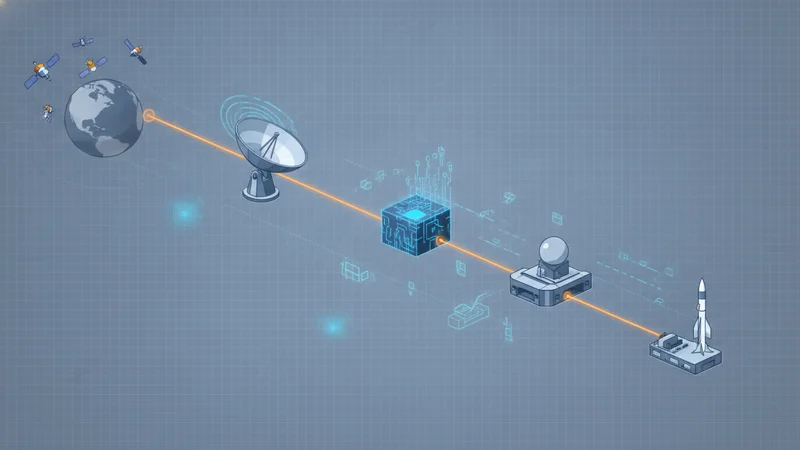
Two threat-inventory entries reach the Critical zone of this assessment’s risk matrix, and only two: a tripled ISR constellation feeding PLA tracking and targeting (T9, score 25.0) and long-range precision-strike kill chains extending past the previously assumed mainland limit (T10, score 25.0). The two threats are, in practice, one process, unfolding in four operational phases:
- Custody. Continuous ISR coverage establishes persistent tracking of adversary force dispositions.
- Fusion. That targeting-quality data is fused with China’s BeiDou positioning constellation, itself dual-use by declared design since a 2016 white paper framed it as serving national security and economic development simultaneously.
- Strike. The fused product is handed to precision-strike systems whose effective range has grown beyond planners’ prior assumptions.
- Doctrine. PLA doctrinal writing, reinforced by observed lessons from Russia’s war in Ukraine , explicitly calls for early degradation of adversary command, control, and sensing infrastructure at the outset of conflict.
How to read. Each of the 24 threats in this assessment (T1…T24) gets a composite risk score = Likelihood × Impact × Vulnerability. Likelihood and Impact run 1–5 (5 = highest); Vulnerability is a 0.75–1.25 factor for how structurally exposed the position already is. Bands: ≥21 Critical, 15–20 High, 6–14 Medium, <6 Low. The resulting decimals (e.g., 18.75) are an artifact of multiplying three analyst-assigned ordinal judgments, not a measured quantity — treat the band, not the decimal, as the load-bearing signal. Full threat descriptions and scores are in “Risk Framework” in the Glossary at the end of the article.
| Impact 1 | Impact 2 | Impact 3 | Impact 4 | Impact 5 | |
|---|---|---|---|---|---|
| L5 | T9 | ||||
| L4 | T4, T5, T18, T24 | T2, T17, T23 | T10 | ||
| L3 | T7, T8, T13, T20 | T3, T6, T12, T19, T22 | T11, T21 | ||
| L2 | T16 | T14, T15 | T1 | ||
| L1 |
The matrix distribution is bimodal rather than concentrated. The two Critical entries (T9, T10) sit apart from a nine-entry High zone (T2, T4, T6, T11, T17, T18, T21, T22, T23) that spans demonstrated kinetic and jamming capability, an inferred cyber vector against ground infrastructure, documented proliferation cases, and pure deterrence-structure risk with no associated weapon system at all. That heterogeneity matters for prioritization. A defensive posture built only around hardening against kinetic or cyber threats would leave roughly half of the High-zone risk untouched.
The vulnerability multiplier attached to both Critical-zone entries — 1.25 on this framework’s scale — reflects a specific asymmetry, not a generic aggravating factor. The growth in Chinese ISR reach has not been matched, in the evidence reviewed here, by a comparable pace of US and allied counter-ISR or space-domain-awareness investment. That asymmetry also qualifies the peer-reviewed “manageable” reading most directly. That source’s own analysis notes that China’s expanding reliance on space for precision-strike targeting cuts both ways: it complicates Beijing’s ability to deny the United States the military benefits of space, just as it complicates Washington’s ability to deny them to China. Mutual vulnerability tempers, but does not eliminate, the underlying exposure. The practical implication favors proliferated, distributed allied ISR and communications architectures over exquisite, monolithic assets. Distribution reduces the payoff of any single custody-denial or strike action against either side’s constellation. It also addresses the exposure at its source, rather than at the point of eventual conflict.
The command-and-control phase of this chain is its least resolved link, for two independent reasons. First, the still-unsettled division of labor between the Aerospace Force and the Information Support Force means the internal handoff from ISR custody to strike authorization sits astride an organizational boundary that outside observers cannot yet map with confidence. Second, and more fundamentally, China-security specialists disagree, even now, on how centrally PLA counterspace decisions are actually made. Gregory Kulacki and Jeffrey Lewis, writing for the Carnegie Endowment, point to evidence that the 2007 anti-satellite test reflected limited civilian-leadership briefing and technocratic momentum rather than deliberate top-down signaling. Ashley Tellis, also at the Carnegie Endowment, argues instead that the program has been centrally authorized and coordinated by the Central Military Commission from the outset . That disagreement, unresolved nearly two decades after the event it concerns, is itself instructive. If specialists with access to primary Chinese sources cannot converge on the intent behind the best-documented historical case, real-time interpretation of a future incident should be expected to carry at least as much uncertainty.
The highest-leverage point for disrupting this chain is not the terminal strike phase but the reconnaissance and custody phase that precedes it. Sustained ISR coverage is itself trackable and, because the space domain is structurally transparent by nature, observable by the party being tracked. Disrupting custody through denial, deception, or maneuver breaks the chain earlier, and at lower cost, than attempting to intercept a strike once launched. It works against both the offensive targeting chain described above and any Chinese counterspace attack on a US or allied satellite, since both processes depend on the same underlying ISR, positioning, and communications infrastructure. Investment that denies or degrades custody has spillover value against both.
Commercial dual-use entanglement is proliferating risk beyond the US-China dyad
The strongest documented-case evidence in this entire assessment is not about capability at all. It is about proliferation. Two named Chinese commercial firms, Spacety and Chang Guang Satellite Technology , have been sanctioned by the US Treasury and State Departments for supplying satellite imagery to the Wagner Group and to Houthi forces respectively (T18, score 15.0). The sanctions actions were taken in 2023 and April 2025. This is a documented transfer of targeting-relevant capability from a nominally civilian Chinese commercial sector to non-state armed combatants in two separate active conflicts, not an inferred pathway or a doctrinal projection. It extends the strategic-stability question well beyond a purely bilateral US-China frame.
The mechanism that makes this possible is structural rather than incidental. Military-Civil Fusion, formalized through a Central Commission chaired by Xi Jinping since January 2017 (T17, score 20.0), grants the Chinese state continuous legal authority to compel civilian-to-military technology transfer. That means contractual “civil end-use” assurances, the kind foreign partners might rely on, are legally insufficient on their face. The compulsion authority sits with Beijing regardless of what a commercial counterparty intends or promises. That legal asymmetry already motivated the US Commerce Department’s 2020 expansion of export controls. Washington, in other words, identified and partially adapted to this specific threat vector years ago — a comparatively mature policy response relative to the deterrence and organizational-integration risks discussed elsewhere in this assessment.
The two sanctioned firms sit atop a considerably larger footprint. China has built or expanded satellite ground infrastructure in at least 64 countries since 2000, three-quarters of them in the Global South, through state-owned contractors including China Great Wall Industry Corporation and the China Academy of Space Technology. That footprint establishes proliferation-relevant infrastructure well beyond the two documented sanctions cases. It also shows why the export-control response, however mature relative to other risk categories, has structural limits. The 2020 Commerce Department expansion can restrict outbound US technology transfer to China, but it cannot reach Beijing’s internal application of dual-use capability that already sits inside Chinese commercial firms. The legal asymmetry runs through compulsion authority, not through any single export transaction. Control-regime effectiveness, in other words, is bounded by where the technology already resides, not solely by how tightly any single government polices its own exports.
Two findings should temper how this proliferation risk is generalized rather than amplify it. First, conversion complexity varies sharply by technology. BeiDou’s dual-use status required no technical modification at all, since Beijing declared it dual-use by design. Commercial imagery required scarcely more: the same product sold commercially proved directly usable by combatant recipients, with no purpose-built military alternative. But the broader commercial sector’s 400-plus firms vary considerably in how easily their outputs convert to military utility. Second, and more importantly for calibration, no publicly available evidence supports Military-Civil Fusion diversion in China’s civilian nuclear program specifically. That absence demonstrates dual-use risk is sector-specific, not uniform across every domain Beijing’s fusion policy touches. A governance response built on the premise that Military-Civil Fusion is dangerous everywhere would misallocate scarce monitoring effort. One calibrated to conversion complexity fits the evidence better: tightest where conversion is cheapest — imagery tasking, positioning signal access — and lighter where genuine military-specific engineering is still required.
A parallel accelerant operates on the workforce rather than the hardware side. The Aerospace Information University in Jinan , tied explicitly to China’s “air-space-ground integration” strategy, is building a civil-military human-capital pipeline. That pipeline feeds both the Information Support Force and the commercial space sector from the same talent base. It is a proliferation mechanism that current institutional-tier sourcing on PLA organizational structure covers only thinly, and likely understates relative to its long-term significance.
Deterrence signaling gaps, not capability balance, are worsening fastest
Two credible institutional sources reach apparently opposed verdicts on the same underlying picture. The Center for Naval Analyses finds that only two of ten factors it identifies as shaping US deterrence of Chinese use of force in space actually favor successful deterrence, and recommends an explicit US declaratory policy on missile-warning satellite attacks precisely because the current ambiguity risks inadvertent nuclear instability. The peer-reviewed International Security analysis cited earlier concludes the overall balance is more manageable than many analysts fear. On inspection this is not a factual dispute. The two sources are answering different questions: one about the structure of deterrence factors and signaling channels, the other about the resilience of the overall military balance. Both can be correct simultaneously. That reconciliation matters for how a reader should treat the tension: not as a choice between sides, but as a reminder that even the more reassuring reading of the capability balance leaves the signaling problem untouched.
That signaling problem is, by the evidence assembled here, the weakest link in the entire relationship. No side — the United States, Russia, or China — has publicly articulated which counterspace actions would trigger nuclear retaliation (T21, score 18.75), even though the 2022 US Nuclear Posture Review leaves open that unspecified “high consequence, strategic-level attacks” could qualify. No US-China space de-confliction hotline exists at all (T22, score 15.0). Kari Bingen, director of the CSIS Aerospace Security Project and a former US deputy under secretary of defense for intelligence, has described how a routine collision-warning email between the two sides may not even get answered . PLA doctrine appears to concentrate investment precisely in the reversible, gray-zone instruments of China’s own toolkit — jamming, proximity operations, commercial dual-use tasking. That pattern is consistent with operating below whatever threshold might trigger a defined response, precisely because that threshold remains undefined. Rising PLA space-escalation risk tolerance (T23, score 16.0) — documented in research prepared for the US Air Force , drawing on authoritative Chinese-language sources — compounds a mutual threat-inflation dynamic running in both directions, not a purely Chinese opacity problem. US signaling has itself been internally inconsistent: a hawkish December 2025 Pentagon assessment was published alongside conciliatory presidential rhetoric downplaying China as the target of a separate program.
The evidence reviewed here clusters heavily in a single rung of an escalation ladder. Routine tracking and ISR growth sit at the bottom, largely unconstrained today. Reversible instruments occupy a gray-zone rung immediately above it — the same jamming, proximity operations, and commercial dual-use tasking already identified as PLA’s investment focus. Here they surface explicitly as a lower-rung instrument for a Taiwan contingency that integrates space ISR and targeting with cyber and electronic warfare . Above that sits an undefined threshold-crossing rung — a debris-generating kinetic strike or an attack read as touching strategic-warning infrastructure — where the evidence base offers no clear boundary at all. Controlled escalation — reciprocal hold-at-risk action against the roughly 500-plus PLA ISR satellites — is already a subject of open debate among US officials. Cross-domain escalation, integrating space, cyber, and electronic-warfare effects in a Taiwan scenario, is explicitly modeled in available analysis as a deliberate operational concept, not a speculative one. The uncontrolled endpoint — a nuclear-relevant misattribution of what was intended as a conventional strike against dual-use infrastructure — is exactly the scenario the declaratory-policy recommendation discussed below is designed to foreclose.
None of the resilience factors that offset the capability categories discussed above apply here with comparable strength. Distributed satellite architectures reduce the payoff of a single kinetic strike. Mutual space dependence gives both sides an incentive against unrestrained escalation. But neither factor supplies a channel for real-time clarification once ambiguous action is already underway. The diplomatic track, built around China’s sustained preference for a comprehensive treaty banning weapons in space and a parallel civil-cooperation program including the International Lunar Research Station , offers a working relationship that could in principle be leveraged during a crisis. It is worth noting that this track is more differentiated from Russia’s diplomatic behavior than the “China-Russia axis” framing common in mainstream commentary allows. But a working relationship is not a crisis mechanism, and nothing in the current evidence base suggests the hotline or red-line gap is closing.
Implications
None of these three risk vectors is well served by a mitigation strategy built around any single instrument. Hardening satellites and diversifying constellations addresses the kill-chain exposure and the physical vulnerability underlying it, but does nothing for the proliferation or signaling gaps, which require legal, diplomatic, and institutional remedies instead.
In the immediate term, the tripled-ISR-constellation figure driving the top-scored entry in this assessment rests on a trade-press summary of the underlying Pentagon report, not the primary document. It should be cross-checked against that source before being cited as a precise multiplier in further analysis. Hedges flagged in the underlying research — including contested causal claims about what restrained Chinese debris-generating testing after 2007 — should be preserved, not smoothed into settled fact.
Over six to twelve months, the resolving division of labor between the Aerospace Force and the Information Support Force is worth tracking as a discrete monitoring item. Its resolution will materially sharpen confidence on the cyber and command-and-control questions raised above. And the Center for Naval Analyses’ declaratory-policy proposal on missile-warning satellites deserves explicit consideration as the single most concrete, actionable deterrence-strengthening measure identified in this research base.
Over one to three years, establishing even a basic US-China space-safety communication channel — comparable to the existing US-Russia hotline — addresses the most consistently cited structural gap in this assessment. Export-control regimes for Military-Civil Fusion-relevant technology would benefit from the same sector-specific calibration that the nuclear-sector counterexample demonstrates is achievable, rather than uniform restriction applied indiscriminately across a 400-firm commercial base.
The single decision this assessment argues for first is not a capability investment at all. It is prioritizing custody-and-signaling remedies — hotline and declaratory policy — ahead of platform-level hardening, because the evidence here indicates the mechanisms for containing a miscalculation are further behind the threat curve than the mechanisms for surviving an attack.
Limitations
Every threat judgment above rests on inference from capability, doctrine, and organizational structure — not on a declared Chinese counterspace doctrine, which does not exist in public form. This is the single caveat under which the entire assessment operates. Likelihood, impact, and vulnerability ratings involve analytical judgment throughout, particularly for the cyber and directed-energy entries, where no direct China-specific indicator exists in the underlying research. A different analyst applying the same framework could reasonably score several mid-tier entries differently. This assessment is a snapshot of an organizational structure still in transition. The Aerospace Force and Information Support Force division of labor, in particular, should be treated as provisional. Nuclear electromagnetic-pulse threats are deliberately excluded from the quantified inventory as a technically distinct category from the kinetic and non-kinetic counterspace instruments assessed here. Institutional-tier sourcing on PLA organizational structure remains thin relative to think-tank and news coverage. No standalone Chinese state-media rebuttal to the Pentagon’s 2025 assessment was independently available for this analysis. Finally, this assessment traces compounding pathways narratively — for example, how a signaling misperception event could plausibly trigger a kinetic response — without modeling cascading failure probabilities quantitatively. That remains an open task for any subsequent scenario-planning exercise.
Glossary
Risk framework (article-specific)
- T1…T24 — Threat identifiers used in the risk matrix above, organized in six categories:
- Kinetic and co-orbital counterspace
- T1 — renewed debris-generating direct-ascent kinetic ASAT strike against a LEO asset (12.5)
- T2 — co-orbital rendezvous-and-proximity operations against high-value GEO satellites (20.0, High)
- T3 — latent kinetic BMD-derived ASAT capability held in reserve (12.0)
- T4 — ground-based EW jamming of SATCOM from forward-deployed sites (15.0, High)
- Non-kinetic and emerging counterspace
- T5 — reversible RF jamming/dazzling against ISR and SATCOM assets as an escalation-control tool (12.0)
- T6 — cyber intrusion against ground-segment/TT&C infrastructure (15.0, High)
- T7 — directed-energy laser dazzling of optical space-surveillance sensors (9.0)
- T8 — AI-enabled automated sensor tasking compressing observation-to-custody timelines (9.0)
- ISR-to-targeting kill chain
- T9 — tripled on-orbit ISR constellation enabling PLA tracking and targeting (25.0, Critical — highest-rated alongside T10)
- T10 — long-range precision-strike kill chains extending beyond the 400–600 km assumed mainland limit (25.0, Critical)
- T11 — early C4ISR-degradation concept of operations at conflict onset (18.75, High)
- T12 — robotic-arm/refueling servicing capability enabling clandestine repositioning (12.0)
- PLA organizational integration
- T13 — incomplete Aerospace Force/Information Support Force mission delineation (9.0)
- T14 — Information Support Force prioritization concentrating information-dominance doctrine (4.5, Low)
- T15 — leadership/institutional instability from the corruption purge (6.0)
- T16 — expanding civil-military human-capital pipeline (3.0, Low)
- Dual-use and Military-Civil Fusion
- T17 — MCF legal-compulsion mechanism bypassing civil end-use export-control assurances (20.0, High)
- T18 — commercial satellite imagery proliferation to non-state armed combatants via sanctioned PRC firms (15.0, High)
- T19 — commercial space sector functioning as a gray-zone instrument in contingency planning (12.0)
- T20 — BeiDou dual-use PNT infrastructure embedded in declared national-security posture (9.0)
- Deterrence and misperception
- T21 — absence of nuclear red lines for counterspace attacks on strategic-warning satellites (18.75, High)
- T22 — no US-China space de-confliction hotline (15.0, High)
- T23 — rising PLA space-escalation risk tolerance combined with mutual threat inflation (16.0, High)
- T24 — absence of declared Chinese counterspace doctrine forcing inference-based threat assessment (12.0)
- Kinetic and co-orbital counterspace
- L × I × V — Risk score formula: Likelihood × Impact × Vulnerability.
- Likelihood 1–5 — probability of occurrence within the assessment horizon (5 = highest)
- Impact 1–5 — severity of consequence if the threat materializes (5 = highest)
- Vulnerability 0.75–1.25 — how structurally exposed the position already is; 1.0 is neutral, 1.25 marks a documented asymmetry (such as unmatched allied counter-ISR investment), 0.75 marks a partially offsetting factor
Key Figures — Sources & Evidence
The table below traces every load-bearing figure in this assessment back to its source and states how strongly the research base supports it. “Single source” means the figure is directional — the best available public estimate, not a settled, independently confirmed number. Treat it accordingly when citing further.
| Figure | Value | Source | Evidence |
|---|---|---|---|
| ISR constellation growth | Tripled since 2018 (as of January 2024, per DoD assessment) | Breaking Defense | Single source (trade-press summary of the Pentagon report; cross-check against the primary DoD document recommended) |
| Long-range kill chain reach | Extends beyond the 400–600 km mainland limit previously assumed by planners | International Security | Corroborated (peer-reviewed academic assessment) |
| Former Strategic Support Force personnel scale | 200,000–250,000 personnel (roughly 10–12% of the PLA) | Jamestown China Brief | Single source (citing USCC congressional testimony) |
| Commercial ground-infrastructure footprint | Built or expanded in at least 64 countries since 2000, three-quarters in the Global South | CSIS Hidden Reach | Corroborated (cross-checked against commercial satellite imagery and US Treasury/State sanctions actions) |
| Commercial space sector size | More than 400 firms (as of 2022) | CSIS | Single source (policy-prescriptive analysis, not peer-reviewed) |
| US deterrence-factor balance | Only 2 of 10 identified factors favor successful US deterrence | Center for Naval Analyses | Conflict (see Limitations) — in tension with the “manageable” peer-reviewed reading above |
| PLA ISR satellite count (hold-at-risk debate) | Roughly 500-plus satellites | SCMP | Single source (named on-record speaker) |
| US-China space de-confliction hotline status | None exists; a routine collision-warning email “may not even get answered” | SCMP | Single source — same named on-record speaker and account as the row above |
Primary Sources & Research
State Council Information Office (2022). China’s Space Program: A 2021 Perspective (White Paper). gov.cn. https://english.www.gov.cn/archive/whitepaper/202201/28/content_WS61f35b3dc6d09c94e48a467a.html
State Council Information Office (2016). China’s Space Activities (White Paper). gov.cn. https://english.www.gov.cn/archive/white_paper/2016/12/28/content_281475527159496.htm
State Council Information Office (2016). China’s BeiDou Navigation Satellite System (White Paper). CNSA. https://www.cnsa.gov.cn/english/n6465652/n6465653/c6480542/content.html
Federation of American Scientists (n.d.). Prevention of an Arms Race in Outer Space (PAROS). FAS. https://programs.fas.org/ssp/nukes/ArmsControl_NEW/nonproliferation/NFZ/NP-NFZ-PAROS.html
NASA Johnson Space Center (2008). Measurements of the Small Particle Debris Cloud from the 11 January 2007 Chinese Anti-Satellite Test. NASA Technical Reports Server. https://ntrs.nasa.gov/citations/20080014830
Miguel Yagües Palazón / ESA (2020). Young Lawyers’ Symposium 2020. ESA Indico. https://indico.esa.int/event/331/contributions/5507/
Todd Harrison / CSIS Aerospace Security Project (2019). Congressional Testimony: China in Space. CSIS. https://aerospace.csis.org/congressional-testimony-china-in-space/
CSIS Aerospace Security Project (2019). Space Threat Assessment 2019. CSIS. https://aerospace.csis.org/space-threat-assessment-2019/
Nivedita Raju and Wilfred Wan / SIPRI (2024). Escalation Risks at the Space–Nuclear Nexus. SIPRI Research Policy Paper. https://www.sipri.org/sites/default/files/2024-02/2402_rpp_space-nuclear_nexus.pdf
CSIS Scholl Chair in International Business (n.d.). Unpacking Expanding Export Controls and Military-Civil Fusion. CSIS. https://www.csis.org/analysis/unpacking-expanding-export-controls-and-military-civil-fusion
CSIS China Power Project / Hidden Reach (2025). In China’s Orbit: Beijing’s Space Diplomacy in the Global South. CSIS. https://features.csis.org/hiddenreach/china-space-diplomacy-global-south/
US Department of the Treasury (2023). Treasury Sanctions Company Providing Satellite Imagery to Wagner Group (Press Release JY1220). Treasury.gov. https://home.treasury.gov/news/press-releases/jy1220
US Department of State (2025). Department Press Briefing, April 17, 2025. State.gov. https://www.state.gov/briefings/department-press-briefing-april-17-2025
CSIS Defense and Security Department (2025). Extending the Battlespace to Space. CSIS. https://www.csis.org/analysis/chapter-8-extending-battlespace-space
Gregory Kulacki and Jeffrey Lewis / Carnegie Endowment (2007). A Different View of China’s ASAT Test. Carnegie Endowment for International Peace. https://carnegieendowment.org/events/2007/11/a-different-view-of-chinas-asat-test
Ashley J. Tellis / Carnegie Endowment (2014). Does China Threaten the United States in Space?. Carnegie Endowment for International Peace. https://carnegieendowment.org/posts/2014/01/does-china-threaten-the-united-states-in-space
Mark Hibbs / Carnegie Endowment (2021). Military-Civil Fusion and China’s Nuclear Program. Carnegie Endowment for International Peace. https://carnegieendowment.org/2021/06/10/military-civil-fusion-and-china-s-nuclear-program-pub-84749
Rajeswari Pillai Rajagopalan / Observer Research Foundation (n.d.). ASAT Weapons: A Real Threat to the Future of Space. ORF. https://www.orfonline.org/expert-speak/asat-weapons