
 spacestrategies.org
Key Findings
- India’s 15:1 budget disadvantage relative to NASA creates structural dependency conditions regardless of institutional design, yet India’s Rimland position between continental and maritime powers gives it leverage that no other US partner can offer.
- The gap between India’s STA-1 formal status and operational ITAR access remains the single variable that determines whether the TRUST Initiative produces genuine partnership or performative rebranding; the F414 engine precedent (80% technology transfer) sets the benchmark.
- The observed strategic equilibrium – India cooperates while hedging through BAS and NavIC 2.0 ; the US shares technology while applying cross-domain conditionality – is stable but suboptimal for both parties, and neither side can unilaterally improve its position.
- A misperception spiral is already active: US interprets Indian hedging as defection, applies conditionality (tariffs, Russian oil demands, Operation Sindoor trust deficit), which triggers India’s Kargil GPS-denial trauma, producing more hedging.
Executive Summary
This analysis examines the India-U.S. TRUST Initiative through classical geopolitical frameworks, institutional analysis, identity construction, and strategic choice theory to determine whether it represents genuine partnership or a technology lock-in mechanism. Structurally, India’s value to the United States is a direct function of its non-alignment; full alignment would be self-defeating for both parties. The partnership will deepen incrementally through industry-to-industry channels but will not produce alliance-level integration – and the attempt to force such integration through conditionality is the primary threat to its survival.
The Terrain
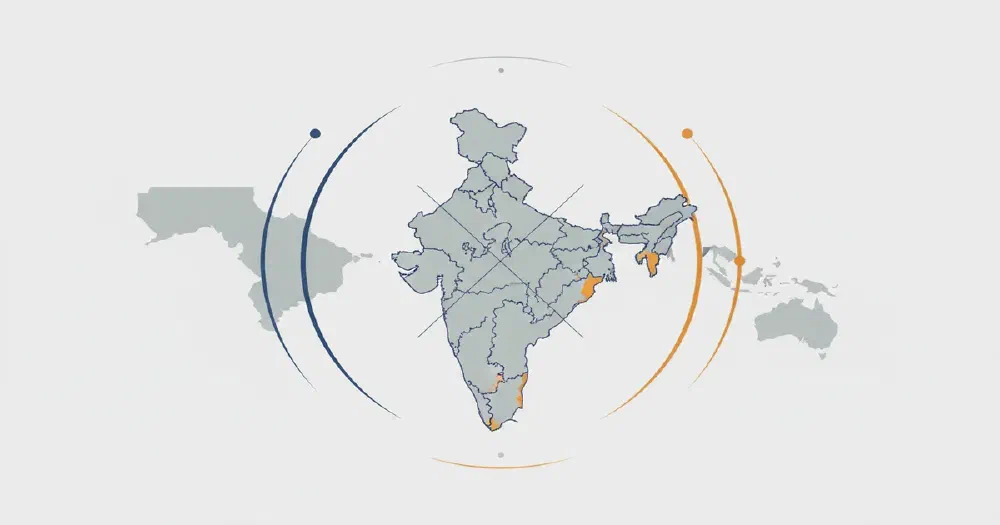
India sits at the hinge of Eurasia’s southern rim – a peninsular power commanding the northern approaches to the Indian Ocean while facing continental threats across the Himalayas. This dual orientation, maritime and continental simultaneously, is the geographic foundation of a strategic paradox that the TRUST Initiative cannot resolve, only manage.
Context and Strategic Question
The Transforming Relations Utilising Strategic Technologies (TRUST) Initiative represents the latest institutional layer in a deepening India-U.S. space partnership that dates to 1963. Building on the bipartisan foundation of iCET (Initiative on Critical and Emerging Technologies) , TRUST bundles space, defence, AI, semiconductors, and biotechnology into a comprehensive technology framework. The strategic question is whether this architecture constitutes genuine partnership between a rising space power and the incumbent hegemon, or whether it functions as a lock-in mechanism that trades Indian strategic autonomy for access to American capabilities.
The question matters because India’s utility to the United States rests on a paradox. Washington values New Delhi because India straddles blocs – BRICS co-founder, SCO member, Global South voice, Artemis Accords signatory. Each deepening of the US space partnership erodes the equidistance that makes India strategically useful as a bridge. Successive crises – CAATSA sanctions over the S-400 purchase , demands to cease Russian oil imports, divergent positions on regional conflicts – test whether cooperation survives when interests collide outside the space domain. The oil dispute reached a provisional resolution in February 2026: Washington cut tariffs on Indian goods from 50 to 18 percent in exchange for an Indian pledge to reduce Russian energy purchases. That pledge remains uncodified. By mid-2026 it faced renewed pressure from a bipartisan Senate sanctions bill targeting Russian-oil importers – a reminder that conditionality of this kind is recurring, not episodic.
The Geographic Foundations
India’s 7,517-kilometre coastline commands the northern Indian Ocean, the conduit for roughly 40 percent of global petroleum trade. Three major chokepoints – the Strait of Hormuz, the Strait of Malacca, and Bab el-Mandeb – fall within India’s projection radius, though none under direct control. The Satish Dhawan Space Centre at Sriharikota, positioned at 13.7 degrees north latitude, provides efficient equatorial launch geometry over open ocean – an advantage no other US partner replicates at comparable cost.
Yet geography also imposes constraints. India imports approximately 40 percent of its petroleum from the Persian Gulf, creating a permanent vulnerability that US sanctions policy can exploit. The Himalayan border with China forces dual-axis security planning that absorbs defence resources. And India’s deep-space communication network lacks global coverage, creating operational dependency on NASA’s Deep Space Network – a concrete indicator of whether partnership means complementarity or subordination.
The geographic bottom line: India offers the United States an Indian Ocean command position combined with equatorial launch advantage. The United States offers India technology access and deep-space infrastructure. The exchange is structurally balanced – but the 14,000-kilometre separation means the partnership is institutional, not territorial. It can be deepened or severed without altering either nation’s geographic fundamentals.
Strategic Position Summary
The ratings below are qualitative syntheses of each lens’s diagnostic fit, not a measured index – useful for comparing the four lenses against each other, not for absolute precision.
| Lens | Position | Assessment | Key Insight |
|---|---|---|---|
| Mackinder (Heartland) | Southern Rimland pivot | Bridges continental Heartland and maritime outer crescent | Full alignment destroys pivot value; TRUST anchors but must not absorb |
| Mahan (Sea Power) | Rising trajectory | Indian Ocean dominance with global blue-water aspirations | Petroleum dependency through Gulf SLOCs creates embedded coercive dimension |
| Spykman (Rimland) | Archetypal amphibious Rimland state | Continental and maritime access simultaneously | Optimal strategy is perpetual non-commitment; both sides compete for orientation |
| Waltz (Structural) | Rising swing state in transitional polarity | Formal non-alignment, operational multi-alignment | Overlapping affiliations are the strategy, not a failure to choose |

The Analysis
Classical strategic logic says states align with or against the dominant power. India does neither – it aligns across powers simultaneously, extracting technology and institutional access from competing blocs while committing fully to none. The question is whether this represents strategic sophistication or a contradiction that geopolitical pressure will eventually collapse.
Through the Classical Lenses
The four lenses below are terrestrial power frameworks mapped onto a space partnership by analogy – Rimland as orbital position, chokepoints as Deep Space Network dependencies. The mapping does real analytical work without being literal; where it strains, the Limitations section flags it.
Mackinder’s framework identifies India as the southern anchor of the Eurasian Rimland, positioned between the continental Heartland – Russia and Central Asia – and the maritime outer crescent dominated by the United States, Japan, and Australia. India’s simultaneous membership in BRICS (Heartland-adjacent) and the Artemis Accords (maritime-Western) is not hedging but geographic destiny. The Rimland state that commits to one side loses the bridging function that gives it strategic weight. China’s Belt and Road Initiative encircles India through the China-Pakistan Economic Corridor and the String of Pearls naval strategy, creating continental pressure that structurally pushes India toward maritime partnership. But the Russian alternative – the S-400, exploratory orbital cooperation discussions, continued energy trade – preserves the continental channel that prevents exclusive Western dependence.
Mahan’s sea power framework reveals why the partnership has natural foundations. India’s peninsular geography, growing naval capability including the indigenous carrier INS Vikrant , and a 200-plus space startup ecosystem all point toward maritime-commercial orientation. Indian and American strategic interests converge most naturally in the Indian Ocean: shared interest in freedom of navigation, complementary surveillance capabilities enhanced by space-based assets, and mutual concern over Chinese naval expansion. The TRUST Initiative’s space situational awareness provisions and the BECA and COMCASA defence agreements reinforce this maritime convergence.
Yet Mahan also exposes the partnership’s coercive underbelly. India’s petroleum dependency routes through chokepoints where American power is decisive. The Strait of Hormuz, through which a still-critical share of Indian energy supplies transits, is reported to have stopped functioning as the geographic mechanism through which Washington translates naval dominance into political leverage, becoming instead the primary node of an asymmetric standoff in which Iran is said to openly challenge US maritime hegemony. Past trade negotiations showed an earlier version of this dynamic, when Washington used its leverage to press limits on Russian oil purchases . The partnership’s maritime foundations remain genuine, but the Hormuz crisis is reported to have exposed a different structural vulnerability: an apparent collapse of the US security umbrella no longer lets Washington use its status to dictate terms, reportedly forcing India to treat Russian crude as a non-negotiable pillar for surviving an Iranian blockade.
Spykman’s Rimland thesis provides the most illuminating framework. India is the archetypal amphibious Rimland state – continental security threats from China and Pakistan, maritime opportunities across the Indian Ocean, and the institutional flexibility to engage both the Heartland and maritime coalitions. TRUST is the American instrument for shifting India’s Rimland orientation toward the Western architecture. India’s indigenous programmes – BAS (Bharatiya Antariksh Station), NavIC 2.0, and Gaganyaan – are the counterweights that preserve Rimland flexibility. The partnership’s stability depends on neither side pushing hard enough to collapse this equilibrium.
Institutional analysis confirms that both sides have genuine demand for cooperation. ITAR and EAR export controls impose massive transaction costs on technology collaboration; the “Trusted Trader” system directly addresses this friction. The institutional infrastructure is already dense – NISAR joint satellite development since 2014 , Artemis membership, defence logistics agreements, the INDUS-X innovation bridge . But the institutions stabilize at a shallow depth. India engages in deliberate forum shopping: Artemis for lunar access, COPUOS for Global South legitimacy, BRICS for continental options, bilateral deals with France and Italy for diversification. This forum shopping maximizes its bargaining position while diluting Washington’s anchoring objectives. The fragmentation is functional for India and frustrating for the United States.
The identity dimension sets hard limits that no institutional architecture can override. India’s non-aligned identity is constitutive rather than instrumental: not a tactic to be negotiated away but a self-conception rooted in historical experience. The 1999 Kargil crisis, when the United States denied India GPS access during active military operations , functions as a foundational strategic trauma. Every Indian investment in autonomous navigation (NavIC), independent space stations (BAS), and sovereign human spaceflight (Gaganyaan) traces back to that moment. ISRO Chairman Somanath’s distinction between “co-development” and “vendor” status – voiced directly at the February 2026 Bengaluru Space Forum – captures the identity test: partnership that builds Indian capability is legitimate; subordination that creates dependency is not.
The Structural Position
At the systemic level, the transitional polarity – from US unipolarity toward contested US-China bipolarity – creates structural demand for India’s alignment from both sides. India is the most consequential swing state in this transition.
That system-level shift explains why India functions as the transition’s most consequential swing state: the density of its overlapping affiliations is itself the strategy. And the pressure cuts both ways. The harder Washington and Beijing compete for New Delhi’s orientation, the more leverage India extracts from remaining uncommitted.
At the state level, India operates with a strong executive driving foreign policy but institutional capacity constraints that create a persistent gap between framework ambition and execution. The space economy stands at $8.4 billion – roughly 2 percent of the global market – with an aspirational $44 billion target for 2033. Private funding dropped 55 percent in 2024 , creating demand for US market access and investment that the TRUST framework could facilitate. But India’s democratic structure also creates audience costs: nationalist constituencies demand sovereignty assertion while business constituencies demand technology access. The Modi government manages this by pursuing both simultaneously – a sustainable approach only if Washington does not force a binary choice.
At the individual level, Prime Minister Modi’s personal diplomacy has accelerated the partnership beyond structural predictions, driving continuity from iCET to TRUST across US administrations. But this personalisation creates fragility. The current US administration’s transactional approach – the “three Ts” of TRUST, Tariffs, and Trump – introduces presidential unpredictability as a structural risk. NSC staffing depletion compounds this, threatening implementation of even agreed frameworks.
Where the Theories Converge – and Where They Don’t
The frameworks converge on the same point: India’s strategic value to the United States derives from its non-alignment, and going all-in with Washington would undercut both partners. That convergence is not evenly weighted. Mackinder, Mahan, and Spykman are variants of the same classical-geopolitical, realist tradition, so their agreement functions more as internal consistency than as independent confirmation – and that tradition has a documented tilt toward zero-sum readings (see Limitations). Identity analysis and the formalised strategic interaction start from different premises – norms and self-conception in one case, rational strategic choice in the other – so their arrival at the same conclusion carries more weight. Mackinder identifies the Rimland pivot whose value lies in bridging blocs. Mahan shows Indian Ocean complementarity that works best without subordination. Spykman explains why both powers compete for India’s orientation rather than its obedience. Identity analysis reveals why India resists alignment even when material incentives favour it. And the formalised strategic interaction confirms the same pattern: the observed outcome – India cooperates while hedging, the US shares while conditioning – is an equilibrium that holds, though neither side can shift it unilaterally in its own favour.
The frameworks diverge on sustainability. Mackinder’s logic implies that intensifying Heartland-Rimland competition eventually forces a choice – India cannot indefinitely maintain deep partnerships with both the US and Russia. Spykman, however, suggests that Rimland states thrive through perpetual non-commitment. The institutional perspective offers a middle ground: overlapping memberships can persist as long as the costs of dual engagement remain manageable. India’s selective normative positioning demonstrates this in practice – it signs the Artemis Accords while abstaining from US-led responsible-behaviour resolutions.
The deepest tension is between material and ideational analysis. The 15:1 budget asymmetry (NASA’s FY2026 budget of $24.4 billion against ISRO’s roughly $1.5 billion ) predicts Indian bandwagoning that has not materialised. Identity analysis explains the gap: the Kargil trauma and non-aligned self-conception impose constraints that override material calculations. But this also means the partnership is more fragile than structural analysis alone suggests. A single coercive episode – technology access conditioned on political compliance, echoing the GPS denial – could collapse the cooperative progress built over decades.
The dominant framework for this case is Spykman’s Rimland thesis. The core dynamic – an amphibious state managing competing bids for its alignment while maximising flexibility – maps directly onto India’s strategy of networked autonomy . TRUST is Washington’s instrument for shifting the Rimland orientation; BAS, NavIC 2.0, and diversified partnerships are New Delhi’s instruments for maintaining it.

The Outlook
The structural constraints are clear: India will cooperate but never commit; the US will share but never unconditionally. The strategic choices that matter now operate within these limits, not against them.
Strategic Implications
For India, the optimal path is to deepen TRUST engagement at the industry level. The Axiom-Skyroot partnership and GalaxEye’s collaboration with SpaceX are the model: ties like these prove more resilient to political disruption than government-to-government frameworks. India should pair that deepening with credible investment in autonomous alternatives. BAS need not be financially viable as an independent programme; it must be viable enough as a bargaining chip. Each TRUST deepening should be balanced by visible autonomous milestones to maintain domestic legitimacy and non-aligned credibility.
For the United States, the highest-leverage action is extending F414-level technology transfer to space components. The export control bureaucracy – not Indian reliability – is the primary obstacle. Every instance of cross-domain conditionality (tying space cooperation to trade disputes or energy policy) damages the reputation for reliability that sustains Indian cooperation. The structurally sound approach is to treat space as a protected domain insulated from broader political friction, making TRUST valuable enough that India chooses closer cooperation voluntarily rather than being coerced into it.
For third parties, the partnership will deepen without becoming exclusive. China should expect continued Indian participation in BRICS and SCO space discussions. European partners – France, Italy, ESA – occupy a valuable diversification niche that reduces India’s binary calculation. Russia’s relevance as a space partner depends on its ability to deliver operational capability, which has declined under fiscal and sanctions pressure.
The long-term trajectory favours gradual institutionalisation through commercial channels. As India’s private space sector matures, the partnership shifts from government-to-government frameworks – vulnerable to political disruption – toward industry-to-industry integration that creates path dependencies harder to reverse. Axiom Space’s exploration of Indian launch vehicles for its station missions is arguably the most durable foundation for cooperation that neither government can fully control or fully abandon.
Limitations
Classical geopolitical frameworks were designed for terrestrial power politics; their application to space cooperation requires analogical reasoning – Rimland-as-orbit, chokepoints-as-Deep-Space-Network-nodes – that may overstate structural determinism. Several data points central to the analysis remain single-source or unverified, including the reported 35 percent increase in Trusted Trader component trade and the F414 80 percent technology transfer figure. The analysis operates on a 5-to-15-year horizon where structural factors dominate; short-term catalysts – leadership change, military crisis, technological breakthrough – could rapidly alter the equilibrium. Realist frameworks systematically underweight cooperative outcomes, and the exclusion of cyber vulnerabilities, AI-enabled operations, and SpaceX market dominance effects represents a significant analytical boundary.
Primary Sources & Research
NASA (n.d.). Artemis Accords. NASA. https://nasa.gov/artemis-accords
NASA (n.d.). NASA Strategic Partnerships. NASA. https://www.nasa.gov/partnerships/
NASA (n.d.). NASA Export Control and Interagency Liaison. NASA. https://www.nasa.gov/oiir/export-control/
NASA/JPL (n.d.). How US-Indian NISAR Satellite Will Offer Unique Window on Earth. NASA. https://nasa.gov/missions/nisar/how-us-indian-nisar-satellite-will-offer-unique-window-on-earth
ASI (2025). Italy-India Aerospace Roadshow 2025. Agenzia Spaziale Italiana. https://www.asi.it/2025/09/italy-india-aerospace-roadshow-2025/
Carnegie Endowment for International Peace (2025). TRUST and Tariffs. Carnegie Endowment. https://carnegieendowment.org/posts/2025/06/trust-and-tariffs
Carnegie Endowment for International Peace (2025). The India-US TRUST Initiative: In Space We TRUST: New Horizons. Carnegie Endowment. https://carnegieendowment.org/china/posts/2025/04/the-india-us-trust-initiative-in-space-we-trust-new-horizons
Observer Research Foundation (2026). The US-India Space Collaboration: A Perspective from Emerging Frontiers. ORF. https://www.orfonline.org/expert-speak/the-us-india-space-collaboration-a-perspective-from-emerging-frontiers
Observer Research Foundation (2025). Introducing NavIC 2.0: Leveraging India’s Strategic Space Advantage. ORF. https://www.orfonline.org/expert-speak/introducing-navic-2-0-leveraging-india-s-strategic-space-advantage
Beyond the Horizon (2025). India’s Multi-Vector Strategy: Autonomy Through Networked Power. Beyond the Horizon ISSG. https://behorizon.org/indias-multi-vector-strategy-autonomy-through-networked-power/
Secure World Foundation (2025). Practical Governance Tools for Space Sustainability. SWF. https://www.swfound.org/
SatNews (2026). US-India Space Forum Convenes in Bengaluru to Solidify TRUST Initiative Framework. SatNews. https://satnews.com/2026/02/11/us-india-space-forum-convenes-in-bengaluru-to-solidify-trust-initiative-framework/
Reuters (2024). US Startup Axiom Space Explores Using Indian Rockets for Space Mission. Reuters. https://www.reuters.com/technology/space/us-startup-axiom-space-explores-using-indian-rockets-space-mission-2024-11-05/