
 spacestrategies.org
Key Findings
- 4 of 6 PESTLE dimensions register as high-impact threats, with only the economic (medium, pre-revenue) and social (low, limited public salience) dimensions below the threshold – the most adversarial macro-environment identified for any current space governance question.
- A severely constrained number of viable South Pole sites combine permanent illumination and water-ice access – NASA has identified only 9 candidate landing regions, and extreme lighting conditions narrow operational terrain further; a single safety zone at Shackleton Ridge can exclude competitors from the highest-value terrain in cislunar space.
- OST Article XII provides an independent exclusion pathway for restricting access to installed infrastructure – unaddressed by UNCOPUOS Principle 4(C), which targets only “safety zones” by name.
- Operational timelines lead governance by 2-3 years: crewed Artemis landings from 2028 will establish safety zone precedent before ATLAC reports (2027 deadline) and before any UNCOPUOS principles are adopted.
- The Artemis Accords’ deliberate under-specification of zone radius, duration, and revocation is a normative design choice that privileges first movers – replicating the ADIZ pattern where undefined parameters enable incremental expansion without legal remedy.
Executive Summary
This analysis examines the macro-environment shaping lunar safety zones – the operational deconfliction mechanism introduced by Artemis Accords Section 11 and rejected by the ILRS/COPUOS framework – across political, economic, social, technological, legal, and environmental dimensions for the period 2026-2032. The political and legal dimensions dominate, driven by U.S.-China strategic competition exploiting deliberate treaty ambiguity, while the extreme geographic concentration of viable South Pole sites transforms an abstract governance question into an acute resource control problem. The overall directional assessment is that the current environment structurally favors a deconfliction-to-possession trajectory, with multilateral countermeasures procedurally too slow to alter the outcome before operational precedent is set.
The Landscape
The central paradox of lunar safety zones is that they are designed to prevent conflict while being structured in ways that guarantee it. Two incompatible governance regimes will be operationalized at the same physical sites before any coordination mechanism exists.
Context and Scope
The entity under examination is the lunar safety zone concept as defined by Artemis Accords Section 11 and contested by the ILRS/UNCOPUOS framework , with focus on the South Pole operational theater. The geographic scope encompasses the Shackleton, de Gerlache, Haworth, and Sverdrup crater systems, alongside the international governance forums where these zones are being defined or challenged – UNCOPUOS, Artemis Accords Principals Meetings, and ILRS coordination bodies. The analysis horizon spans 2026-2032, from the current pre-operational phase through first crewed landings to expected operational consolidation. The focal concern is whether safety zones will function as temporary operational deconfliction tools or evolve into de facto territorial control instruments, replicating a pattern well-documented in terrestrial governance.
The Macro-Environment at a Glance
| Factor | Impact | Trend | Net Valence |
|---|---|---|---|
| Political | High | ↑ | Threat |
| Economic | Medium | ↑ | Mixed |
| Social | Low | → | Mixed |
| Technological | High | ↑ | Threat |
| Legal | High | ↑ | Threat |
| Environmental | High | → | Threat |
The Operating Environment
The legal and political dimensions form the dominant axis of the macro-environment, each reinforcing the other in ways that accelerate the deconfliction-to-possession trajectory.
The legal architecture is deliberately incomplete. The Outer Space Treaty provides the foundational prohibition on appropriation (Article II) and the obligation of due regard (Article IX), but the operational gap between these principles and on-the-ground implementation is where the safety zone ambiguity resides. The Artemis Accords’ Section 11 fills this gap with safety zones framed as due regard compliance – yet the text specifies neither radius, duration, nor revocation conditions. This is not oversight but normative design: the Accords use aspirational language (“intend to”) rather than mandatory obligations (“shall”), and provide no mechanism for contesting another party’s zone declaration. The normative hierarchy is clear in theory – binding OST obligations are paramount – but the OST does not define what constitutes “use” (permitted) versus “occupation” (prohibited). The declaring party self-determines the boundary.
Against this permissive architecture, the UNCOPUOS Working Group has mounted the most significant multilateral challenge to date. Three successive drafts through 2025 culminated in December’s Principle 4(C) , which states explicitly that safety measures “shall not be used as a basis for establishing ‘safety zones’ or any arrangements that could amount to de facto appropriation.” The emerging “selective accommodation” model – accepting resource extraction only if embedded in governance with sunset clauses and third-party verification – represents the most credible compromise pathway. But it faces a structural timing problem: UNCOPUOS operates by consensus, which any spacefaring nation can block, and the ATLAC consultation framework (established 2024, due 2027) will deliver recommendations after operational precedent has already been set by crewed Artemis missions from 2028.
A critical finding from the treaty architecture concerns OST Article XII, which requires that stations and installations be open to other parties on a reciprocal basis – but implicitly acknowledges that installations exist and that access may be conditioned. This creates a legally independent pathway to exclusion that persists even if safety zones are successfully constrained by name. UNCOPUOS Principle 4(C) targets “safety zones” specifically; it does not address installation-based access restrictions under Article XII.
Political competition is the primary accelerant. The U.S. leads 61 Artemis Accords signatories; China and Russia anchor the 13-signatory ILRS, which rejects the safety zone concept entirely and advocates COPUOS-based multilateral governance. These are not merely parallel programs – they represent incompatible normative orders for the same physical territory with no interoperability mechanism. U.S. domestic political framing has moved from scientific exploration to strategic dominance: a summary accompanying a Senate bill calls for the U.S. to “dominate the Moon, control strategic terrain in space, and write the rules of the 21st century.” NASA’s March 2026 IGNITION initiative , pivoting from Gateway to surface base construction through private competition, prioritizes physical presence – the precondition for safety zone declarations. Within the Artemis coalition, coherence is uncertain: European signatories face autonomy pressures, and the rapid expansion from 54 signatories (April 2025) to 61 (January 2026) broadens the coalition but may dilute operational consensus.
The first U.S.-China operational space communication occurred in October 2025 , a collision-avoidance contact that opens a narrow bilateral channel. But the Wolf Amendment constrains expansion, and no mechanism bridges the Artemis-ILRS governance divide at the policy level. Viewed through the lens of institutional design, the “community” governing the lunar South Pole is divided by low trust, divergent norms, and near-zero prior cooperation experience – precisely the conditions that commons governance research identifies as most unfavorable for self-governing solutions.
Geographic and Technological Constraints
The physical environment is the hardest constraint and the factor most favorable to first movers. Unlike orbital slots or spectrum, a safety zone at one South Pole site physically constrains access to adjacent sites.
The Scarcity of Viable Terrain
NASA has identified only 9 candidate landing regions at the lunar South Pole, and extreme lighting and thermal conditions narrow operationally viable terrain further. The Sun never rises more than 7 degrees above the horizon , creating conditions never experienced in human spaceflight. Unlike orbital slots or spectrum – which can be coordinated through time-sharing – a safety zone at one South Pole site physically constrains access to adjacent sites. Zones are not independent; they form an interconnected exclusion geometry.
The resource dimension deepens this constraint. Water-ice deposits are finite and non-renewable on human operational timescales. Chinese scientists published a high-resolution water-ice thermal stability model for Shackleton in February 2026, confirming the resource intelligence guiding site selection on both sides. Once extraction begins, first-mover advantage is permanent – the resource does not regenerate. This transforms safety zones from procedural instruments into resource allocation mechanisms.
The Verification Gap
No dedicated cislunar space situational awareness system exists . Safety zone compliance is self-reported and unverifiable – whoever builds the first monitoring infrastructure gains not just situational awareness but de facto enforcement authority. The positioning, navigation, and timing (PNT) infrastructure that will define how zone boundaries are measured does not yet exist as a shared standard; whoever builds the lunar navigation reference frame defines the geometry of exclusion. Nuclear fission reactors planned for lunar bases introduce a radiation-hazard justification for exclusion zones that is technically legitimate and harder to contest than resource-extraction safety zones – operating independently of the Artemis framework entirely.
Secondary Dimensions
Economic and social dimensions are secondary but not inert. The cislunar economy remains pre-revenue; economic significance hinges on whether in-situ resource utilization proves commercially viable. But NASA’s restructured Artemis lander competition and the IGNITION surface-base initiative are creating commercial incentives for early site control. The social dimension has the lowest current impact – public engagement with lunar governance is limited, and media framing reduces the issue to a “space race” narrative – but it carries a latent legitimacy risk. If safety zones are perceived as mechanisms for wealthy nations to appropriate common heritage resources, the political backlash could parallel deep-sea mining debates under UNCLOS, where developing nations’ exclusion delegitimized the governance framework.

Where Factors Converge
Three reinforcing loops dominate the macro-environment, each accelerating the trajectory from deconfliction to possession before institutional countermeasures can take effect.
The Political-Legal-Environmental Loop
Great-power competition exploits the deliberate ambiguity of Artemis Section 11 to declare safety zones at geographically concentrated sites, creating exclusion through practice before governance institutions can respond. Each unilateral declaration strengthens the precedent for the next, and the physical scarcity of alternatives means excluded parties have no equivalent options. This is the same pattern documented in Air Defense Identification Zones, the closest terrestrial structural parallel to lunar safety zones – unilateral declaration in international space, no treaty basis, no defined parameters, and escalation from identification to control without legal remedy. China’s 2013 East China Sea ADIZ provoked diplomatic protest but no legal remedy; the lunar South Pole offers even less recourse.
The Technology-Legal Verification Gap
The absence of cislunar monitoring makes safety zone compliance unverifiable, which means the first operator to deploy surveillance infrastructure gains de facto enforcement authority. This is not merely a technical gap – the institutional rules governing the lunar commons contain no information-sharing requirement, no mandatory advance notification, and no shared operational database. The information asymmetry is structural and, by the design of both frameworks, intentional.
The Economic-Environmental Resource Lock-In
Water-ice deposits are finite, extraction is rival, and economic value will escalate as cislunar operations scale. Safety zones around extraction sites function as de facto resource allocation boundaries, and the first-extraction advantage is permanent.
The Multilateral Counterweight
Against these reinforcing dynamics, the UNCOPUOS institutional counterweight provides a dampening effect – but a weakened one. Principle 4(C) and the selective accommodation model would require sunset clauses and third-party verification, potentially transforming zones from unilateral declarations into regulated instruments. Yet this remedy addresses only scope and authority rules. It does not address payoff rules (no sanctions for non-compliance), information rules (no mandatory notification), or aggregation rules (consensus enables any spacefaring nation to block adoption). The UNCLOS model demonstrates that defined zone parameters – the 500-meter limit on exclusion zones around installations – combined with institutional dispute resolution can contain safety-to-control drift. But the Antarctic Treaty analogy, often invoked as a model, relied on two conditions absent on the Moon: no economically viable resource at the time of the freeze, and a functioning inspection regime.
The Outlook
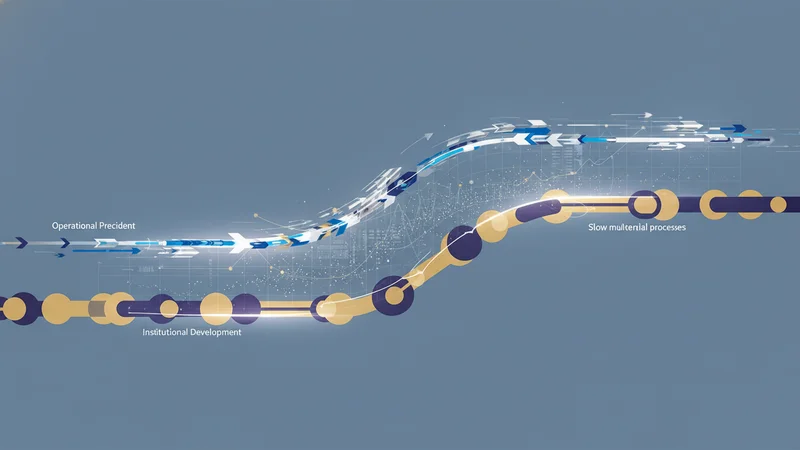
The gap between what multilateral governance needs – time, trust, and institutional capacity – and what the operational environment allows – rapid, unilateral, precedent-setting action – defines the strategic horizon for lunar safety zones.
What This Means
For Artemis Accords signatories, the first safety zone declarations will function as constitutional moments: the parameters chosen for radius, duration, and activity scope will define the operational interpretation of Section 11 for all subsequent missions. Transparency and advance notification – as committed at the 2026 data-sharing workshop – can preempt legitimacy challenges but also reveal operational intelligence. The Article XII installation-access pathway should be anticipated as the primary exclusion mechanism if safety zones are successfully constrained; legal planning must account for both pathways.
For ILRS partners, rejecting the safety zone concept does not eliminate the exclusion risk. Physical presence and Article XII create de facto control regardless of which governance framework is invoked. Robotic precursor operations at Shackleton (Chang’e 7 ) represent an opportunity to establish counter-precedent through demonstrated coexistence – if coordination channels can be opened despite the Wolf Amendment constraint.
For UNCOPUOS and multilateral institutions, Principle 4(C) must be complemented by defined zone parameters (maximum radius, mandatory sunset duration) and a verification mechanism to have operational effect. Normative prohibitions without operational content will be bypassed by practice – as every terrestrial precedent confirms. ATLAC’s 2027 deadline should be accelerated or supplemented by an interim coordination protocol; delivering recommendations after operational precedent is set reduces them to post-hoc commentary.
For commercial operators, safety zone parameters will function as de facto resource allocation mechanisms. Investment in independent cislunar monitoring capability provides both operational advantage and governance leverage – whoever builds the first independent verification system defines what “compliance” means in practice. The Aerospace Corporation’s recommendation to develop definitions of cislunar protected regions for flight safety illustrates how technical standards bodies are already shaping the boundary logic.
The single most consequential force in this environment is the race between operational precedent and institutional development. Every indicator suggests precedent will win.
What to Monitor
ATLAC interim outputs (Political/Legal): Any interim coordination protocol before the 2027 final report would signal that multilateral governance is accelerating to match operational timelines. Source: UNCOPUOS Legal Subcommittee sessions and ATLAC working papers.
First explicit safety zone notification (Legal/Technological): The parameters – radius, duration, activity scope, revocation conditions – of the first formal notification under Artemis Section 11 will establish the interpretive template. Source: NASA mission documentation , Artemis Accords Principals Meeting communiques.
Cislunar SSA deployment (Technological): Any announcement of dedicated lunar surface or cislunar monitoring infrastructure by any actor transforms the verification landscape. Source: NASA, CNSA, and commercial provider mission manifests.
UNCOPUOS Principle 4(C) adoption status (Legal/Political): Whether the December 2025 draft advances toward adoption or is blocked by consensus objection will signal the strength of the multilateral dampening effect. Source: COPUOS plenary sessions and General Assembly resolutions.
Limitations
This analysis covers 2026-2032; mission timelines are subject to delay (Artemis has slipped repeatedly ), and faster Chinese progress at Shackleton could compress the window. ILRS operational planning details are not publicly available, and the ILRS signatory count may have increased beyond 13 since September 2024. The analysis assumes both programs proceed on broadly current trajectories – a major technical failure or political shift could alter the picture. Commons governance frameworks developed for terrestrial resources require adaptation for environments where excludability is a function of technological capability rather than geographic proximity. The legal and political dimensions overlap significantly and are separated here for analytical clarity, but they interact continuously in practice.
Primary Sources & Research
NASA (2026). Artemis Accords. NASA. https://nasa.gov/artemis-accords
NASA (2026). NASA Celebrates Five Years of Artemis Accords, Welcomes 3 New Nations. NASA. https://www.nasa.gov/organizations/oiir/artemis-accords/nasa-celebrates-five-years-of-artemis-accords-welcomes-3-new-nations/
NASA (2026). NASA Strengthens Artemis, Adds Mission, Refines Overall Architecture. NASA. https://www.nasa.gov/directorates/esdmd/nasa-strengthens-artemis-adds-mission-refines-overall-architecture/
NASA (n.d.). Characterizing the Visual Experience of Astronauts at the Lunar South Pole. NASA NESC. https://nasa.gov/centers-and-facilities/nesc/characterizing-the-visual-experience-of-astronauts-at-the-lunar-south-pole
Aerospace Corporation (2024). Space Safety Institute Compendium. Aerospace Corporation. https://aerospace.org/sites/default/files/2024-12/SSICompendiumBook_2024-12_FINAL.pdf
Xinhua (2026). Chinese Scientists Publish Water-Ice Thermal Stability Model for Shackleton. Xinhua. https://english.news.cn/20260227/404c567a54394e19a093832fb8d57929/c.html
Secure World Foundation (n.d.). Lunar Space Cooperation Initiatives. SWF. https://www.swfound.org/publications-and-reports/lunar-space-cooperation-initiatives
ESA (2025). Towards a Safe and Sustainable Cislunar Space. ESA Space Safety. https://blogs.esa.int/spacesafety-community/2025/07/17/towards-a-safe-and-sustainable-cislunar-space/
Jakhu & Pelton (2025). UNCOPUOS and the Quiet Transformation of Space Resources Law. EJIL:Talk! https://www.ejiltalk.org/uncopuos-and-the-quiet-transformation-of-space-resources-law/
CSIS Aerospace Security Project (2025). Space Threat Assessment 2025. CSIS. https://www.csis.org/analysis/space-threat-assessment-2025
CSIS Futures Lab (2024). Collective Defense in Space. CSIS. https://www.csis.org/analysis/collective-defense-space
Observer Research Foundation (2025). Space Geopolitics: Europe’s Call for Autonomy. ORF. https://www.orfonline.org/expert-speak/space-geopolitics-europe-s-call-for-autonomy
Lunar Policy Platform Foundation (2025). All Eyes on the Moon: Sharing Information for Lunar Peace, Safety and Sustainability. SpaceNews. https://spacenews.com/all-eyes-on-the-moon-sharing-information-for-lunar-peace-safety-and-sustainability/
SpaceNews (2025). China and U.S. Take Initial Steps Toward Space Traffic Coordination. SpaceNews. https://spacenews.com/china-and-u-s-take-initial-steps-toward-space-traffic-coordination/
For All Moonkind (2025). Space Law Doesn’t Protect Historical Sites, Mining Operations and Bases on the Moon. The Conversation. https://www.theconversation.com/space-law-doesnt-protect-historical-sites-mining-operations-and-bases-on-the-moon-a-space-lawyer-describes-a-framework-that-could-255757
Scientific American (2026). China’s First Moon Astronauts Could Land at This Surprising Site. Scientific American. https://www.scientificamerican.com/article/chinas-first-moon-astronauts-could-land-at-this-surprising-site/