
 spacestrategies.org
Key Findings
- Two operational L-band SAR spacecraft (SAOCOM-1A, 2018; SAOCOM-1B, 2020 ) are approaching or past their 5-year notional design life on a budget sustained by roughly 260 CONAE staff , with no funded successor.
- Across the 4×4 dimensional matrix, the Efficient row — the people — is the only dimension hollowing at every level simultaneously. Material, Formal and Final remain substantively intact.
- Argentine science funding fell 32.9% in real terms in 2024 while SIDE intelligence spending rose 52%; the 2026 Ley 27.798 contains no consolidated “space line.”
- Decree 901/2025 (22 December 2025) closed a two-year governance vacuum by appointing five ad-honorem cross-ministerial directors, none of them space-sector technocrats.
- The November 2025 Pampas flood placed roughly 5 million hectares under water, materially activating the agricultural lobby as a latent political constituency for SAOCOM continuity.
Executive Summary
This analysis examines CONAE and its SAOCOM L-band SAR constellation as a single sovereign-capability complex and asks what structurally holds it together in 2026. Read through the four Aristotelian dimensions, the entity shows an unusual failure geometry. The hardware flies. The architecture survives on paper. The purposes are over-determined enough that even hostile administrations claim them as trophies. But the human substrate that animates all three is being depleted faster than any other layer. CONAE can be killed without being formally dismantled. The window in which that outcome becomes irreversible is measured in budget cycles, not decades.
The Entity
Argentina is simultaneously a producer and a host of strategic space infrastructure — a bidirectional asymmetry no other Latin American actor occupies, and the structural puzzle this analysis exists to explain.
Argentina operates the only L-band synthetic aperture radar constellation in the Western Hemisphere, on the budget of a small national meteorological service. At the same time, it hosts one of ESA’s deep-space tracking antennas at Malargüe on its own soil. That bidirectional asymmetry — producing and hosting strategic space infrastructure at once — is the structural puzzle this analysis exists to explain.
Context and Strategic Question
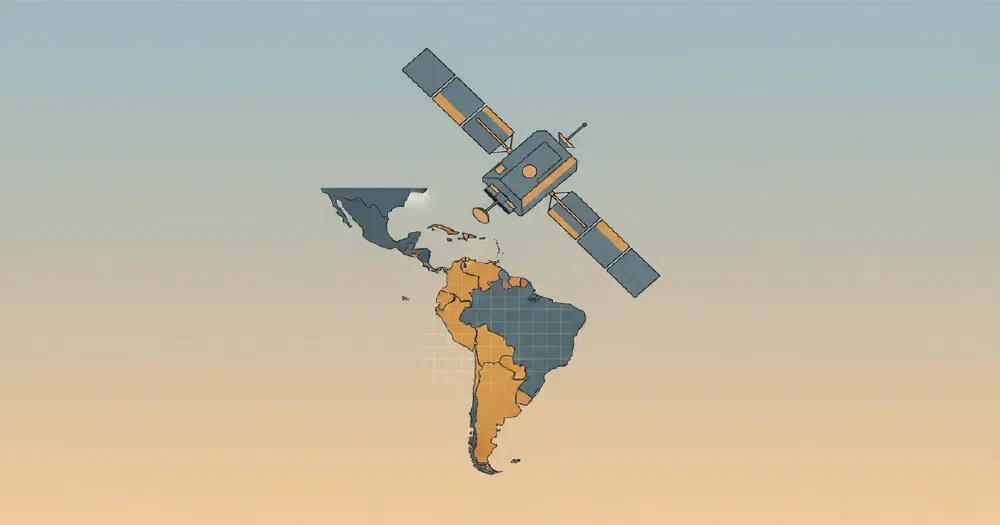
CONAE is the smallest space agency in the Western Hemisphere running a frontier sovereign asset. It was founded in 1991, out of the reconversion of the Cóndor missile programme , and placed under the Foreign Affairs ministry. Staffed at roughly 260 people , it is tied to an industrial base — INVAP in Bariloche, VENG at Falda del Carmen, INTA in the Pampa Húmeda — that between them took a civilian L-band radar from silicon to operational soil-moisture maps. SAOCOM-1A launched in October 2018, SAOCOM-1B in August 2020 , both on Falcon 9. They fly inside SIASGE, the historically first inter-frequency SAR constellation, twinned with Italy’s X-band COSMO-SkyMed quartet.
The question the 4dimensions© lens is meant to answer is not whether CONAE is in crisis — it plainly is. The real question is how an institution this small, operating an asset this advanced, has held together for thirty years across multiple fiscal collapses — and where the structural supports of that improbable equilibrium are now fracturing. The stakeholders whose decisions will determine the next chapter include CONAE leadership and its workforce, INVAP and VENG, the Milei executive and Congress, the Italian Space Agency, NASA and the US State Department after the March 2025 US–Argentina bilateral space consultations , ESA as Malargüe host, the Pampas agricultural constituency, and the Latin American peer agencies watching the “build-and-operate” model as a structural data point.
The Entity in Focus
Seen concretely, SAOCOM is two spacecraft of INVAP heritage in Sun-synchronous low Earth orbit, carrying active phased-array antennas tuned to the ~1.275 GHz L-band microwave window. That 23-centimetre wavelength is why the radar can penetrate cloud cover, foliage canopy and the top few centimetres of dry soil. The ground segment is two antennas, at Falda del Carmen in Córdoba and in Tierra del Fuego, feeding into a mission control. From there, a downstream processing chain fuses SAR returns with INTA’s in-situ soil-moisture probes in the Pampa Húmeda to produce Argentina’s flagship agricultural product.
Around that core sits a wider apparatus: INVAP as satellite prime, VENG as launch and ground operator, IAR as R&D and SME channel, INTA as downstream co-developer. A bilateral ICD with ASI synchronises tasking with COSMO-SkyMed. A Contributing Missions framework with ESA’s Copernicus pushes data outward into European climate services. A small CubeSat-class payload, Atenea, is booked to fly on NASA’s Artemis II — small in mass, oversized in diplomatic weight. From the L-band physics of the payload to the hectare-resolution soil-moisture map delivered to a provincial INTA station, the entire value chain is domestic. The single externally supplied material element is the launcher.
Dimensional Summary
| Dimension | Core Assessment | Key Finding |
|---|---|---|
| Material (Assets) | Hardware operational, workforce depleting | The vulnerability is the people, not the spacecraft |
| Formal (Architecture) | Procedurally intact, governance hollowed | Plan Espacial Nacional survives on paper as its carriers are replaced |
| Efficient (Operators) | Uniformly hollowing at every level | Founding generation exiting with no coherent successor cohort |
| Final (Mission) | Over-determined, contested | Same asset claimed by incompatible coalitions |
The Analysis
The four dimensions of CONAE do not fail together. They fail at different rates, and the gap between the fastest-eroding dimension and the slowest-eroding dimension is itself the structural story.
What follows organises that asymmetry thematically, then climbs the levels from L-band physics to bilateral diplomacy to locate where the tension becomes load-bearing.
Through the Four Dimensions
Start with what the entity is made of. The material dimension of CONAE rests on four non-negotiable physical givens: L-band radar physics, the Sun-synchronous orbital regime, the radiation environment of LEO, and the territorial geometry of Argentina itself. That geography stretches from sub-tropical Pampas to sub-Antarctic Tierra del Fuego. It generates both the operational demand (floods, soil moisture, oil spills across millions of hectares) and the geographical value (high-latitude ground reception, dark-sky tracking sites) that makes the country structurally attractive to foreign space agencies. On those foundations sit the INVAP-built SAR payload with its T/R modules and on-board processing, the INVAP spacecraft bus, the two ground antennas, the INTA in-situ sensor network that anchors cal/val, and — treated here as a material substrate though it belongs formally to the Efficient dimension — the approximately 260-person workforce that integrates, operates and maintains the chain. At the system level, the entity is two spacecraft plus ground segment plus the joint soil-moisture service. At the supersystem level, it is SIASGE, Copernicus Contributing Missions, and the small symbolic insertion of Atenea into Artemis II. The hardware is in good condition. The bottleneck is aging assets with no funded replacement (the next-generation SAOCOM-CS successor remains a study) and a workforce that VENG layoffs in Córdoba , stagnant salaries, and the departure of named twelve-year technicians are visibly thinning. The vulnerability of CONAE is not its radar. It is the people who know how the radar was built.
The formal dimension was designed to outlast the people. CONAE’s architecture is built around Conrado Varotto’s multi-decadal Plan Espacial Nacional, codified in INVAP-CONAE engineering specifications and bilateral ICDs with ASI, plus the ABACC regional-transparency regime that lets Argentina operate a dual-use radar without triggering neighbour-state arms-race dynamics. That architecture is an unusually coherent stack at the subsystem and system levels. The incoherence is at the top. Between 2023 and late 2025 CONAE operated under a governance vacuum. Decree 901/2025, issued on 22 December 2025, closed that vacuum by appointing five ad-honorem directors drawn from the Ministry of Human Capital, Economy, Foreign Ministry and the Secretariat of Innovation, Science and Technology — cross-ministerial political figures rather than space-sector technocrats. The 2026 Ley 27.798 fragments space funding across multiple budget lines with no consolidated “space line,” which renders the sovereign capability fiscally invisible and easier to erode piecemeal. The architecture survives. What has failed is the mechanism by which it reproduces its own carriers. The formal reading — grounded on the decree and budget facts, inferred on the trajectory — is that CONAE is being hollowed rather than dismantled.
The efficient dimension shows the sharpest break in the anatomy. CONAE’s founding generation is exiting the stage. Varotto retired in May 2018. Periferia reported that technical director Raúl Kulichevsky resigned after the two-year governance vacuum, while workers’ communiqués described SAOCOM, SARE and SABIA-Mar as paralysed. Below them, the subsystem layer — INVAP engineers, VENG operators, and named CONAE technicians such as Daniel Aguirre , with twelve-plus years of institutional memory — is shrinking through layoffs and attrition. Above them, the Hurtado-circle science-policy community that gave the founding cohort its discursive coherence is aging without visible successors. The Milei executive simultaneously cuts CONAE funding by roughly 20% in real terms and claims CONAE successes — Atenea, Artemis II — as political trophies . The workforce has publicly rejected this formal-informal asymmetry. A regional outlet reported that the April 2026 strike was suspended specifically to protect Atenea operations — perhaps the cleanest expression of how the remaining technical staff use sovereign-mission prestige as both shield and bargaining chip. That SIDE intelligence spending rose 52% in real terms while science fell 32.9% in 2024 is the values choice of a government, made legible in arithmetic.
The final dimension has kept the rest from collapsing. CONAE’s purposes are over-determined. At the foundational layer, the mission is sovereign public-good access to space-based observation, inherited from the post-Cóndor reconversion and explicitly tied to peaceful use, regional transparency and equitable access for non-traditional users. At the system layer, operational soil-moisture monitoring in the Pampa Húmeda, flood-extent mapping, oil-spill detection in Patagonia and hydrocarbon monitoring produce measurable, politically legible value. At the supersystem layer, three competing purposes coexist: CONAE as the standing demonstration that a mid-income country can build-and-operate rather than diplomatically-accede; SIASGE as peer-partnership currency with a major European space power; and Atenea and the March 2025 US bilateral consultations as diplomatic-symbolic capital that even an austerity administration finds valuable to claim. The over-determination has bought time. It has also opened the door to capture: each additional claimant on CONAE’s prestige fragments the coalition that would have to fund renewal. Declared purpose and revealed purpose remain broadly aligned, but a third operative purpose has crept in — the executive treating CONAE as a low-cost reputational asset to be harvested rather than maintained.
Across the Levels
Read vertically rather than horizontally, CONAE shows a decisive upward propagation chain and an equally decisive downward one. Upward: L-band physics at the foundational layer makes INVAP’s T/R-module and antenna competence strategically meaningful at the subsystem layer. That competence produces the SAOCOM platform and INTA fusion service at the system layer. And the platform plus service are what make SIASGE an inter-frequency constellation differentiator at the supersystem layer. Absent the underlying physics — the cloud and canopy penetration that no commercial X- or C-band provider substitutes — the entire sovereign-capability argument collapses into expensive duplication. A second upward chain runs from ABACC regional trust through dual-use legitimacy through unconstrained operational use to diplomatic peer status with Italy and the US.
The downward chain is faster and more dangerous. Milei austerity doctrine at the supersystem-formal level becomes the 2026 budget envelope and Decree 901/2025 at the system-formal level. That becomes VENG layoffs and CONAE attrition at the subsystem-efficient level. That, in turn, becomes erosion of the human substrate at the foundational-material level — workforce is functionally part of the material base of this entity. The tightest couplings in CONAE are hardware-to-workforce at the subsystem level and SIASGE-to-bilateral-politics at the supersystem level. The most consequential mismatch is between the subsystem and system reality — functional, technically excellent, internationally validated — and the supersystem governance signals of austerity, an ad-honorem board and public narrative contradiction. The form at the top no longer matches the substance at the bottom. The cascade risk, grounded in its elements and inferred in its speed, runs top-down faster than any bottom-up regeneration cycle can keep pace.
Where the Dimensions Converge — and Where They Don’t
The three dimensions of Material, Formal and Final broadly converge on the same reading: CONAE is an unusually coherent complete institution that delivers a capability no commercial provider substitutes, whose architecture was built to outlast administrations, and whose purposes are sufficiently redundant that it cannot easily be cancelled outright. Where the Efficient dimension enters, all three converging lines bend. The workforce that makes the hardware meaningful, that animates the architecture, and that carries the foundational purposes through time is being depleted simultaneously at every level of the matrix. This is not the standard space-agency failure mode, in which programmes are cut and people linger. It is the inverse: the programmes survive and the people leave.
Together, the four dimensions produce something no single dimension could: the sovereign-capability paradox this analysis opened with. A frontier SAR asset on a meteorological-agency budget becomes possible only when cheap-but-deep human capital, inherited multi-decade architecture, end-to-end material ownership and over-determined purpose all hold simultaneously. Remove any one and the paradox collapses. A second emergent property is the bidirectional asymmetry: Argentina simultaneously operates its own sovereign system and hosts ESA’s Malargüe deep-space station (DSA-3) , a dual standing as producer and host that no other Latin American actor occupies. A third is the narrative-contradiction durability: Atenea is claimed by coalitions with incompatible purposes, and — counter-intuitively — that dissonance has so far protected the asset rather than destroyed it.
CONAE in 2026 is not an agency in crisis so much as a sovereign capability complex whose four causal supports are decoupling at different rates. The L-band radar flies, and the data keeps flowing. Mission-ownership architecture remains procedurally intact. The purpose layer is over-determined enough that even hostile administrations still claim it. The workforce is not. The SAOCOM constellation will likely complete its operational life adequately. The open question is whether anything functionally equivalent can be built when it ends.

The Outlook
The dimensional anatomy does not forecast a date. It does tell decision-makers which lever is load-bearing — and inverts the default priority list of a space agency under fiscal pressure.
In practice, that distinction separates which interventions are load-bearing from which are merely decorative.
Strategic Implications
For CONAE leadership and Argentine policy-makers, the first implication is that workforce retention — not next-generation hardware procurement — is the highest-priority structural intervention available. Funding SAOCOM-CS without the engineers to design it would be empty. Consolidating the dispersed space funding into a single legible line in the national budget is not a bookkeeping preference. Fiscal invisibility is itself a structural vulnerability. The November 2025 Pampas flood placed roughly 5 million hectares — an area larger than Denmark — under water. That has surfaced the agricultural constituency as a latent political coalition that does not depend on whichever administration is in power. CONAE leadership has an approximately 24-to-36-month window to anchor that constituency, before workforce erosion makes the capability impossible to market.
For the Italian Space Agency and other international partners — NASA, ESA, JAXA, CNES — the implication is that SIASGE and adjacent cooperation assumptions inherited from the 2018-2022 window need to be updated. The bilateral is sustained by a workforce being actively depleted. Cooperative training, exchange programmes and joint research fellowships that retain Argentine engineers are now structurally more valuable than new joint hardware commitments. Hardware can be built again. Cohort formation takes fifteen to twenty-five years. For Latin American peer agencies — Brazil’s INPE and AEB, Mexico’s AEM — CONAE is the empirical test case of whether “build-and-operate” sovereignty can survive a hostile fiscal cycle. The Secure World Foundation’s Global Counterspace Capabilities assessment provides the open-source baseline against which dual-use national systems such as SAOCOM should be evaluated. The next two to three budget cycles are a structural data point any analogous national programme should monitor. For the industrial base — INVAP, VENG and related SMEs — revenue diversification away from a single hollowing customer is now an institutional-survival imperative rather than an industrial-policy preference.
The structural permanences worth naming: the L-band physics is permanent, the territorial geometry is permanent, and the ABACC regional-trust substrate is permanent. Everything else is time-sensitive, and the single indicator worth monitoring is the net technical-staff headcount at CONAE, VENG and INVAP — the Efficient dimension, measured monthly.
Limitations
The 4dimensions© framework is structural and anatomical. It maps the directional logic of the cascade described here but does not forecast its specific timing. Temporal precision should come from a foresight or geopolitical lens. No peer-reviewed literature on SAOCOM operational cal/val performance, SIASGE constellation operations or CONAE institutional analysis was retrieved. Engineering claims would benefit from IEEE GRSS and CEOS Cal/Val sourcing in any follow-up. Several claims — the CONAE 2026 budget figures, the Kulichevsky resignation circumstances, the VENG layoff counts, the April 2026 strike suspension — rest on single-source reporting that is internally consistent and named but politically flagged; the analysis is sensitive to their accuracy. The Decree 901/2025 appointee roster is also single-outlet but cites the Official Gazette directly, a materially stronger sourcing tier than the other single-source items above. Treating workforce as part of the material substrate sits uneasily with the framework’s strict separation of Material (artefacts) and Efficient (agents). It has been handled here by counting workforce primarily as Efficient, while acknowledging its material-substrate role. The key assumptions are that the political-narrative contradiction around Atenea reflects a coalition pattern rather than ad-hoc opportunism, that the 24-to-36-month horizon is the operative decision window, and that SIASGE renegotiation will track the Argentine domestic trajectory rather than be insulated from it.
Primary Sources & Research
European Space Agency (2024). Malargüe station — ESA Ground Stations. ESA. https://www.esa.int/Enabling_Support/Operations/ESA_Ground_Stations/Malarguee_-_DSA_3
European Space Agency (2025). Copernicus Contributing Missions. Copernicus. https://www.copernicus.eu/en/contributing-missions
NASA / ISRO (2024). NISAR — NASA-ISRO Synthetic Aperture Radar mission. NASA. https://science.nasa.gov/mission/nisar/
INTA Informa (2024). Plataforma CONAE-INTA de monitoreo de humedad del suelo con SAOCOM. INTA. https://intainforma.inta.gob.ar/
Agenzia Spaziale Italiana (2024). Comint approva direttive di governo su spazio e aerospazio. ASI. https://www.asi.it/
Boletín Oficial de la República Argentina (2025). Decreto 901/2025 — Designación de directores CONAE. Boletín Oficial. https://www.boletinoficial.gob.ar/
US Department of State (2025). Joint Statement on US–Argentina Bilateral Space Consultations. State.gov. https://www.state.gov/
IEEE Geoscience and Remote Sensing Society (n.d.). IEEE GRSS — SAR calibration and validation resources. IEEE GRSS. https://www.grss-ieee.org/
Center for Strategic and International Studies (2025). Space News in Brief — March 2025. CSIS Aerospace Security Project. https://www.csis.org/programs/aerospace-security-project/space-news-in-brief/space-news-brief-march-2025
Center for Strategic and International Studies (2025). Orbital Dynamics: Latin American space engagement. CSIS. https://www.csis.org/
Center for Strategic and International Studies (2025). Space, Speed and Sovereignty — Southern Hemisphere analysis. CSIS. https://www.csis.org/
Secure World Foundation (2025). Global Counterspace Capabilities 2025. SWF. https://swfound.org/counterspace/
Carnegie Endowment for International Peace (2025). South Korea’s space industrial policy: KASA and KARI. Carnegie. https://carnegieendowment.org/
Observer Research Foundation (2025). Europe’s pursuit of space autonomy in a fragmented geopolitical order. ORF. https://www.orfonline.org/
Novaspace / Euroconsult (2025). Earth observation satellites in orbit to triple over the next decade. Novaspace. https://www.novaspace.com/
Freire Junior, O.; Hurtado, D. et al. (2015). The end of the Argentina–Brazil nuclear rivalry and the construction of ABACC. arXiv. https://arxiv.org/abs/1506.05859
Fluhr, C. et al. (2022). A cryogenic sapphire oscillator at ESA’s Malargüe deep-space station: a decade of operation. arXiv. https://arxiv.org/abs/2210.05545
Fliger, J. et al. (2024). Instituto Argentino de Radioastronomía: 25+ years channelling R&D into the National Space Plan. arXiv. https://arxiv.org/abs/2401.16597