
 spacestrategies.org
Use of the glossary at the end of the page is essential for understanding the text.
Key Insight
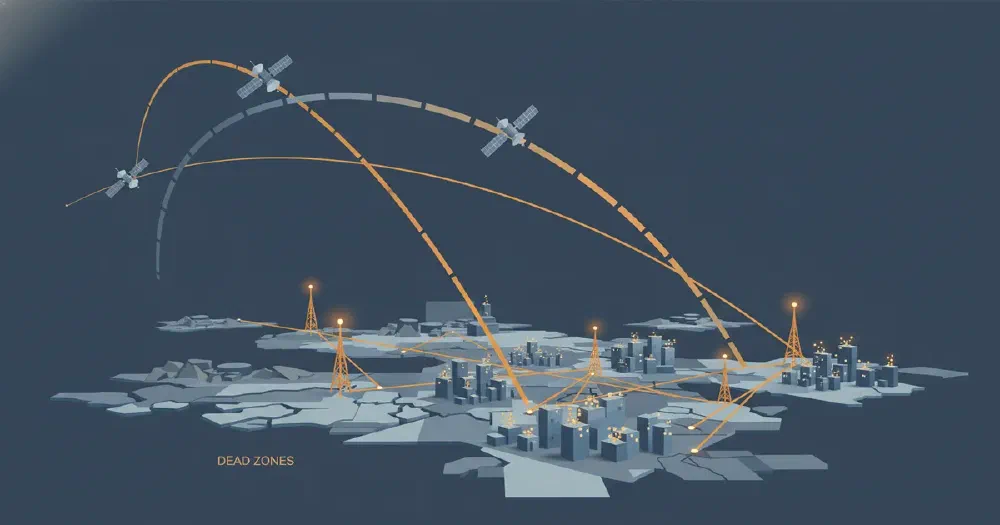
Question. Has Direct-to-Device satellite connectivity already crossed from a Horizon 2 emerging opportunity into a Horizon 1 deployed capability — and if so, is the prevailing “complementary gap-filler” framing still the right lens for the next five years?
Thesis. D2D has already completed its basic-service convergence. As of the February 2025 T-Mobile/Starlink commercial beta , unmodified consumer handsets connect to LEO satellites on terrestrial LTE spectrum, and the category is in early rapid growth rather than late emergence. The remaining uncertainties are not about whether the technology works but about three non-technical constraints: the regulatory ceiling on spectrum scope, the commercial viability of subscriber monetization, and the asymmetry between satellite operators and their mobile network partners. On current deployment cadence, D2D could become the default failover layer of the global communications grid inside the 2028-2031 horizon. A single vertically integrated operator is setting the pace. A policy apparatus designed for an earlier era will decide whether that operator ends up dominant, contested, or fractionally bifurcated against a parallel Chinese stack.
State of the Art
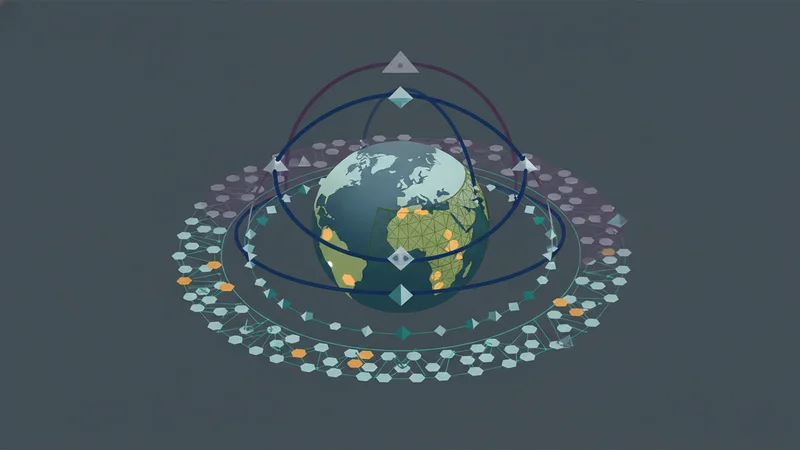
The D2D category exited prototype in 2025: commercial service is live on unmodified handsets, the leading constellation has crossed 650 satellites, and chipsets have become a default smartphone feature.
As of early 2026, D2D satellite-to-cell service is commercially live in the United States, with eight international partner MNOs signed and in various stages of activation. SpaceX’s Starlink direct-to-cell constellation reached roughly 650 satellites by September 2025, up from zero in early 2024 and 400+ by the start of 2025. Another 1,000+ are projected by end-2026, and an FCC request is pending for a further 15,000 . T-Mobile has published the first commercial pricing benchmark at USD 15-20 per month, operating on 5 MHz of Band 25 (1900 MHz) under the FCC’s Supplemental Coverage from Space (SCS) framework adopted in 2024 . AST SpaceMobile, SpaceX’s principal architectural rival, has five BlueBird satellites in orbit against an estimated 45-60 needed for contiguous US coverage, backed by AT&T, Verizon, and Vodafone. Lynk Global operates a third Western ecosystem in partnership with SES and emerging-market MNOs such as MTN. China’s Huawei+Tiantong-1 pairing delivers a GEO-based equivalent on the Mate 60 Pro, with LEO ambitions visible only as ITU filings. Deloitte projected more than 200 million satellite-capable smartphones sold in 2024 — a forecast the flagship-device wave has since borne out directionally — and the chipset has migrated from flagship differentiator to default feature.
The conventional placement across the three horizons, before the 2025 inflection, was clean: constellation deployment in H1, throughput scaling and ecosystem assembly in H2, the failover-layer and dual-use transformation in H3. That placement no longer holds.
Complication
Basic-service convergence moved from prototype to commercial in twelve months. The binding constraints have relocated from engineering to governance and monetization.
What has changed is that the basic-service convergence — text, voice, and limited data on unmodified handsets using terrestrial spectrum from orbit — moved from prototype to commercial service in twelve months. That pace outruns what any three-horizons narrative comfortably accommodates, and it has relocated the binding constraints of the category. The interesting questions are no longer “when will D2D work” or “who will build the constellation first”. They are “how high is the regulatory ceiling on spectrum scope”, “who captures the asymmetric platform value created by the convergence”, and “whether the H1→H2 transition is one the first mover can complete unilaterally through deployment cadence or whether it requires consensus the first mover cannot manufacture”. The Deloitte view that D2D will remain complementary to terrestrial LTE “for the foreseeable future” and the SpaceX view that its V3 generation will deliver LTE-parity consumer experience are, on close reading, a disagreement about which inflection happens first inside the next horizon — not about whether convergence is real. Both may be right, sequentially.
The Argument
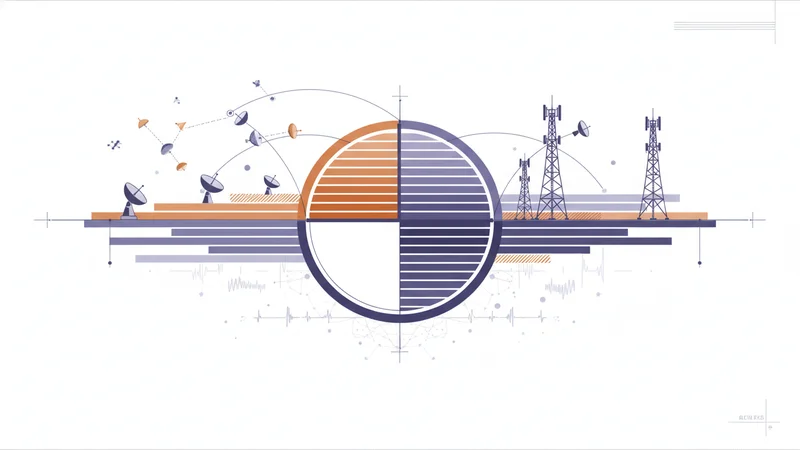
Three forces shape the next horizon: a structural S-curve phase-difference, an asymmetric value-capture contest, and a regulatory ceiling that no operator can vertically integrate.
The deployment lead is a phase-difference on the S-curve, not a head-start
On this analysis, SpaceX is not ahead of its rivals the way runners are ahead in a race; it sits on a different phase of the S-curve. A 400-versus-5 satellite gap in early 2025, widening to 650-versus-5 by September 2025, is a structural phase-difference, not a head-start that faster execution can close. SpaceX’s Starlink D2D constellation is already in late emergence bleeding into early rapid growth, with a launch cadence and vertical manufacturing throughput no other operator can match. AST SpaceMobile and Lynk are still in early emergence. The Chinese LEO curve is pre-emergence, visible only in paper filings. Because the category-level curve is one actor’s curve plus noise, the trajectory of the whole category is effectively the trajectory of a single operator’s execution plan. That makes the trajectory both more legible and more fragile than typical multi-actor technology evolutions.
Horizon by horizon, the picture looks like this:
| Horizon | Focus | Assessment | Key Insight |
|---|---|---|---|
| H1 Maintain & Defend (0-2y) | Vertically integrated SpaceX D2D + MNO alliance + FCC SCS framework | Strong technically and commercially; under pressure regulatorily | First-mover deployment lead is structural, not transient — the 400-vs-5 satellite gap is the dominant fact. |
| H2 Build & Scale (2-5y) | V3 throughput, ecosystem stabilization, monetization proof, regulatory harmonization | Mixed | Constellation scaling is on track; monetization and global regulatory harmonization are not, and these are the binding constraints. |
| H3 Explore & Transform (5+y) | D2D as failover layer of global comms; dual-use institutionalization; 6G-NTN convergence | Well-positioned technically; exposed on governance | The paradigm shift from “satellite as alternative” to “satellite as default failover” is highly likely; the open question is who controls the layer. |
One thing the table cannot convey: SpaceX is stronger in H1 than its rivals, but the deeper fact is that it has exited the emergence phase AST and Lynk are still in. Competitive responses that assume a symmetric race — build more satellites faster — therefore misread the structure of the market. The defensible counter-positioning is architectural (AST’s larger satellites and owned MSS spectrum), geographic (Lynk via SES in emerging markets), or temporal (wait for the next generational leap). A head-on deployment race is ruled out by the phase-difference, not by capital. The USD 17 billion EchoStar spectrum acquisition by SpaceX confirms how the leader reads its own position. The most straightforward reading of a price that size is that the acquirer believes spectrum portfolio scope — rather than more satellites — is the ratchet that converts the deployment lead into an infrastructure-value monopoly. Spectrum lock-in, on this reading, is the next binding constraint. A competitor burning capex to match the constellation while the leader burns capex to widen the spectrum ratchet is fighting the last war.
Convergence is done; the fight is over asymmetric value capture
The second trajectory force is value capture. The cellular-satellite convergence — the literal collapse of two formerly distinct stacks into one operational service — is already done at the base-service level, and the value it creates is captured asymmetrically. The February 2025 T-Mobile/Starlink commercial beta demonstrated every integration interface this analysis treats as required: orbital use of terrestrial bands, the LTE air interface reaching LEO and back without handset modification, authentication and roaming into the MNO core network, cross-tier interference management at scale, multi-jurisdictional authorization via the FCC SCS framework and bilateral extensions, and government activation for emergency use. Every prerequisite the convergence required is in place except two: a durable cross-tier interference governance regime beyond the current dispute-by-dispute FCC adjudications, and viable commercial subscriber monetization. The slowest boat is the regulatory boat, not the radio.
The convergence produces emergent properties: universal coverage with no specialized terminal, a capex-lite inversion of telecom infrastructure, dual-use civilian-military comms as a default capability, disaster-resilient connectivity as a routine commercial service. Platform economics then govern who captures the value those properties create. The MNO partnership architecture that made the convergence possible in H1 is structurally transitional. Capex-lite is a generous framing for the MNO side while D2D is complementary. Once V3-class throughput approaches LTE parity, the MNO is no longer contributing infrastructure; it is licensing spectrum to a partner that has become a potential substitute, and the arrangement turns into a disintermediation risk. The renegotiation inside the 2028-2031 window — institutionalize the alliance with revenue-sharing, or shatter into vertical competition — is more than a scheduling question. The entire H2 value-capture contest organizes around it.
Ecosystem economics sharpen where the asymmetry points. Three Western D2D ecosystems exist on paper — Starlink+T-Mobile alliance, AST+AT&T/Verizon/Vodafone, SES+Lynk+(planned)Omnispace — but only one has the deployment cadence for cross-side network effects to compound. The opposition coalition of legacy MSS operators (Viasat, Globalstar, Iridium, SES, Eutelsat) filing against SpaceX’s 15,000-satellite expansion is the diagnostic signal: it is how an ecosystem reacts to a central player that extracts value from it, rather than to one cultivating the ecosystem’s health. The less visible but more dangerous threat is envelopment at the operating-system layer. If Apple or Google decides to treat D2D as a transparent system feature — an extension of what Apple has already begun with Globalstar’s emergency SOS — the MNO partnership is disintermediated entirely, and every satellite operator in the stack becomes a raw infrastructure provider. Either outcome collapses the platform asymmetry into simpler dynamics than today’s three-cornered picture suggests. Both point to concentrated value capture at or above the constellation tier.
Regulatory governance, not technology, is the binding ceiling on H3
The third trajectory force is the regulatory ceiling: the plateau of the D2D category is set by rules, not by physics. The theoretical ceiling on D2D is a composite of four constraints, all of them regulatory or political: the total MHz that can be authorized in the 1.6-2.7 GHz LTE bands for SCS use; the EPFD and orbital-congestion rules that Matt Pearl and Clayton Swope of CSIS describe as adopted “when the hit social app was MySpace” ; the degree of CEPT and national harmonization in jurisdictions outside the United States; and the political willingness of governments to permanently designate a commercial dual-use capability as essential infrastructure. None of these ceilings can be raised by deploying more satellites or engineering better handsets. None can be brought in-house by the first mover — SpaceX cannot vertically integrate the ITU, CEPT, or the national spectrum regulator of a partner country. That is a significant limit on the “leader burns capex to widen the spectrum ratchet” strategy that worked at the FCC.
Two dynamics make this ceiling the binding H3 constraint rather than a recurring H2 friction. The first is regulatory first-mover lock-in. The ITU rewards filers who establish positions before rivals arrive , so decisions taken in H1 have outsized H3 consequences. The concentration emerging from the current FCC adjudications has limited contestability, because the framework that created it offers little mechanism to revisit it. The second is multi-jurisdictional fragmentation. The 27-plus European national regimes under CEPT mean that European D2D deployment lags the United States by years unless harmonization is forced via the WRC successor process. And the jurisdictions that resolve their rules last become the place where the rival ecosystem best aligned with their domestic politics gains a first-mover position. The pace of a genuinely global footprint in H3 is therefore set by the slowest regulatory processes, even as deployment runs ahead in permissive jurisdictions. For the next horizon that means CEPT harmonization, followed by the quieter question of whether the ITU EPFD regime is modernized or inherited intact into the decade when 15,000+ D2D satellites share the LEO environment with everything else.
Against this backdrop, the dual-use dimension stops being a separate H3 scenario and becomes a regulatory forcing function. Ukraine’s Delta battlefield management system integration , the Helene and Milton and LA wildfire STAs, and the Wireless Emergency Alerts framework have already established two things: consumer D2D networks have wartime and disaster utility, and governmental emergency response depends on a single commercial operator’s decisions. That dependency loop is politically combustible. It pulls in the opposite direction to the commercial concentration the platform dynamics are producing — the more essential the capability becomes, the harder it is to leave its governance to first-mover ITU lock-in. Whether this tension resolves through universal-service designation, explicit government-customer commercial contracts, or a contested reopening of the spectrum and EPFD frameworks is the most important H3 variable. None of the technology trajectories inside the category determine which path it takes.
Implications
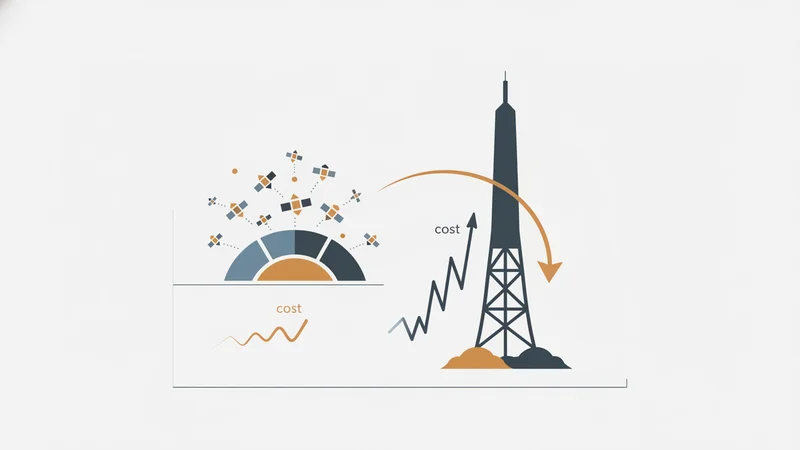
The decision agenda for the next horizon: lock spectrum scope, formalize emergency dependencies, publish subscriber economics, and watch the OS layer.
D2D’s crossing reorders what decision-makers should attend to now and where the leverage actually sits.
Immediately, for decision-makers positioned inside the Starlink/T-Mobile alliance or its rivals, the priority is to lock in spectrum scope before the incumbent MSS opposition coalition succeeds in narrowing it — each MHz authorized in the LTE bands between 1.6 and 2.7 GHz is a one-way ratchet. Defending the FCC SCS framework as a one-regulator template, and pushing it bilaterally into partner-MNO jurisdictions before CEPT crystallizes a fragmented alternative, matters more in the next 24 months than another constellation increment. Emergency-use precedents from Helene, Milton, LA, and Ukraine should be converted into permanent essential-infrastructure designations that cannot be quietly unwound; the political window for that conversion is open now and may not stay open. Credible commercial subscriber economics — not just capex — need to be published inside 12-18 months, or the “monetization unproven” critique will start extracting a political price that the technical success has so far masked. And the OS layer deserves more attention than any additional MNO partnership signing: how Apple and Google decide to treat D2D, as a system feature rather than a per-MNO premium, shapes the entire next-horizon value capture contest.
Over the 2028-2031 build horizon, the investments that matter are V3-class throughput execution, sustaining Starship deployment cadence, multi-jurisdictional regulatory harmonization via active CEPT and ITU and bilateral engagement, and — decisively — a revenue-sharing architecture with MNO partners that survives the moment when D2D becomes a substitute rather than a complement. Alliance cohesion through that asymmetry transition is more than a diplomatic question: it determines whether H2 ends with a stable platform structure or with a renegotiation that fractures the Western market. In parallel, formalizing the FEMA/DOD/allied emergency-services relationships with explicit commercial contracts rather than ad-hoc emergency authorities converts the currently combustible dependency loop into something governed. And engaging 3GPP NTN R17/18 standards work positions the incumbent for the 6G NTN successor curve, which may dissolve today’s D2D platform category into a transparent feature of the integrated network.
What to watch in H3 is a shorter list than the horizon is usually given: whether the Chinese parallel ecosystem operationalizes its ITU filings, whether Apple or Google integrates D2D at the OS level by default, whether a major event triggers universal-service designation of consumer satellite connectivity, and whether the ITU modernizes its EPFD and first-mover rules. Each of these inflections matters more than any further constellation milestone inside the Western ecosystem. The first decision a reader responsible for communications resilience should make, now, is to stop treating D2D as a future capability to be procured separately and start treating it as an operational layer whose governance they are already party to by default — and to act accordingly in spectrum consultations, emergency contracting, and partnership architecture.
Limitations
The Thesis depends on monetization closing the capex gap and on regulatory continuity. Several assumptions are inferential rather than grounded.
The H3 projections rest on assumptions that are plausible but not guaranteed: that SpaceX deployment cadence sustains, that the FCC SCS framework is not reversed, that V3 throughput claims are technically achievable as filed, that interference disputes are resolved without crippling power constraints, and that the dual-use political precedent is not unwound. Confidence declines sharply beyond the 7-year mark. Data gaps constrain several of the claims above. 3GPP NTN specifications, WRC-23 national implementation, AST SpaceMobile commercial and financial timelines, Chinese LEO operational status, and any published D2D subscriber revenue data are absent or thin in the source corpus, which makes the monetization-side reasoning the most inferential portion of the Thesis. The three-horizons frame on which the structural analysis rests favors incremental transition narratives and understates the speed at which the base-service convergence actually moved — twelve months from prototype to commercial beta is a pace the framework does not comfortably accommodate. S-curve positioning is recognized more easily retrospectively than prospectively, and the “approaching inflection” claims for V3 throughput rest on the incumbent’s own forecasts. Platform-ecosystem analysis was developed for consumer internet markets and does not handle cleanly the government-as-customer-regulator-complementor triple role that is, for D2D, the most consequential dynamic in the dual-use dimension. If one finding would collapse the Thesis, it is a demonstration that commercial subscriber monetization cannot close the capex-revenue gap inside the H2 window. The trajectory would remain technically real, but it would lose the economic engine that converts it into the default failover layer projected here.
Glossary
Business and technology
- D2D — Direct-to-Device; connectivity from LEO satellites to unmodified consumer smartphones using standard terrestrial cellular bands.
- MNO — Mobile Network Operator; a terrestrial carrier (T-Mobile, AT&T, Verizon, Vodafone, MTN, etc.) that holds a cellular spectrum licence.
- MSS — Mobile Satellite Service; licensed satellite voice and data service on dedicated mobile-satellite spectrum (distinct from SCS).
- LEO — Low Earth Orbit; roughly 500-2,000 km altitude; the domain of D2D, Starlink, AST SpaceMobile, and Lynk.
- GEO — Geostationary Earth Orbit; ~36,000 km; the domain of Huawei/Tiantong-1’s current D2D implementation.
- LTE — Long-Term Evolution; the 4G cellular air interface, reused in orbit under the SCS framework.
- NTN — Non-Terrestrial Networks; the 3GPP work item that extends cellular standards to satellite, HAPS, and airborne platforms.
- V3 — Starlink’s third-generation direct-to-cell satellite; the throughput step aimed at LTE-parity consumer experience.
Regulation and standards
- FCC — Federal Communications Commission; the US telecom and spectrum regulator.
- SCS — Supplemental Coverage from Space; the 2024 FCC framework authorising orbital use of terrestrial spectrum by SCS-designated operators.
- ITU — International Telecommunication Union; UN body coordinating global spectrum and orbital filings.
- CEPT — European Conference of Postal and Telecommunications Administrations; the 48-country European body that harmonises spectrum decisions across 27+ national regulators.
- WRC — World Radiocommunication Conference; the quadrennial ITU treaty conference that updates the Radio Regulations.
- EPFD — Equivalent Power Flux Density; the ITU limit on signal power from non-GEO satellites into GEO systems, designed to protect incumbents.
- STA — Special Temporary Authority; FCC mechanism for time-limited spectrum use (invoked for Helene, Milton, and LA wildfire D2D activations).
- 3GPP — 3rd Generation Partnership Project; the standards body behind LTE, 5G, and NTN (Releases 17 and 18 are the NTN baselines).
- GSMA — GSM Association; the global industry body representing mobile network operators.
Strategic framework
- H1 / H2 / H3 — horizons of the Three-Horizons framework: H1 “Maintain & Defend” (0-2 years), H2 “Build & Scale” (2-5 years), H3 “Explore & Transform” (5+ years).
- S-curve — the technology lifecycle curve (emergence → rapid growth → maturity → decline) used to locate D2D operators against one another.
Defence and dual-use
- CJADC2 — Combined Joint All-Domain Command and Control; the US-led multi-domain battlefield command architecture, referenced here for Ukraine’s Delta integration as an operational dual-use precedent.
Primary Sources & Research
Federal Communications Commission (2024). FCC Adopts Rules for Supplemental Coverage from Space. FCC. https://www.fcc.gov/document/fcc-adopts-rules-supplemental-coverage-space
NASA SCaN (n.d.). Spectrum Management. NASA. https://nasa.gov/directorates/space-operations/space-communications-and-navigation-scan-program/spectrum
European Space Agency (2024). NTN — Space for 5G and 6G. ESA. https://www.esa.int/ESA_Multimedia/Images/2024/09/NTN_-_Space_for_5G_and_6G
Deloitte Insights (2026). TMT Predictions 2026: Next-Gen Satellite Internet. Deloitte. https://www.deloitte.com/us/en/insights/industry/technology/technology-media-and-telecom-predictions/2026/next-gen-satellite-internet.html
Deloitte Insights (2023). Signals from Space: Satellite-to-Phone Connectivity. Deloitte. https://deloitte.com/za/en/Industries/tmt/research/signals-from-space.html
CSIS — Pearl, M. and Swope, C. (2025). Modernizing Satellite Spectrum Rules Is Key to U.S. Space Leadership. Center for Strategic and International Studies. https://www.csis.org/analysis/modernizing-satellite-spectrum-rules-key-us-space-leadership
CSIS — Bondar, K. (2024). Does Ukraine Already Have Functional CJADC2 Technology?. Center for Strategic and International Studies. https://www.csis.org/analysis/does-ukraine-already-have-functional-cjadc2-technology
East Asia Forum — Taylor, M. (2026). Starlink, China and the Governance of Low Earth Orbit. East Asia Forum. https://eastasiaforum.org/2026/02/19/starlink-china-and-the-governance-of-low-earth-orbit/
East Asia Forum (2026). Standards Are the New Frontier in US-China AI Competition. East Asia Forum. https://eastasiaforum.org/2026/02/03/standards-are-the-new-frontier-in-us-china-ai-competition/
Observer Research Foundation (2025). Digital Affordability and Access: Starlink in India. ORF. https://www.orfonline.org/expert-speak/digital-affordability-and-access-starlink-in-india
Observer Research Foundation (2026). From Satellites to Synthetic Biology: The Dual-Use Dilemma. ORF. https://www.orfonline.org/research/from-satellites-to-synthetic-biology-the-dual-use-dilemma
GSMA (2024). The State of Mobile Internet Connectivity 2024. GSMA. https://www.gsma.com/somic/
Lee, N. et al. (2013). Power Control for D2D Underlaid Cellular Networks. arXiv. https://arxiv.org/abs/1305.6161